
Blog

AIG Insurance’s Privacy Policies And How To Delete Your Data Or Opt Out
AIG Insurance's privacy policy outlines how it collects, uses, and protects customers' personal information. This information includes name, address, and payment information. It is used to provide insurance services, communicate with customers, and provide customer service.
AIG Insurance may share customer information with third-party service providers and affiliates for business purposes. They have measures in place to protect the confidentiality and security of customer information. Customers have the option to opt-out of certain types of communications and to access, update, or delete their personal information.
AIG Insurance may use cookies and other tracking technologies to collect information about customer website usage. They do not knowingly collect personal information from children under the age of 13. Overall, AIG Insurance's privacy policy prioritizes the protection and responsible use of customer data in compliance with applicable laws and regulations.
Analyzing AIG Insurance’s Privacy Practices
AIG Insurance's privacy policy outlines how they collect, use, and protect the personal information of their customers. Here is a detailed analysis of their privacy practices:
Information Collection:
AIG Insurance collects personal information such as name, address, and payment information from their customers. They may also collect information such as social security numbers and driver's license numbers. AIG Insurance collects this information when customers apply for insurance, use AIG Insurance's services, or contact AIG Insurance customer service.
Use of Information:
AIG Insurance uses customer information to provide insurance services, to communicate with customers, and for customer service purposes. They may also use this information for marketing purposes, such as sending promotional offers and newsletters. AIG Insurance may share customer information with third-party service providers and affiliates for business purposes, such as claims processing and customer support.
Protection of Information:
AIG Insurance has measures in place to protect the confidentiality and security of customer information. They use industry-standard security technologies and procedures to prevent unauthorized access, use, or disclosure of customer information. AIG Insurance also restricts access to customer information to authorized employees who need it to perform their job duties.
Opt-Out:
Customers have the option to opt-out of certain types of communications from AIG Insurance, such as marketing emails and calls. They can also access, update, or delete their personal information by contacting AIG Insurance's customer service or using their online account management tools.
Cookies and Tracking Technologies:
AIG Insurance may use cookies and other tracking technologies to collect information about how customers use their website. They use this information to improve their services and personalize customer experiences. Customers can control their cookie preferences using their web browser settings.
Children's Privacy:
AIG Insurance does not knowingly collect personal information from children under the age of 13. They encourage parents and guardians to monitor their children's online activities and to contact AIG Insurance if they believe their child's information has been collected.
Compliance with Laws and Regulations:
AIG Insurance complies with applicable laws and regulations related to privacy and data protection, such as the General Data Protection Regulation (GDPR).
Overall, AIG Insurance's privacy policy prioritizes the protection and responsible use of customer data. They are transparent about their information collection and use practices and provide customers with control over their personal information.
AIG Insurance's measures to protect customer information and restrict access to authorized employees demonstrate their commitment to maintaining privacy. The inclusion of policies related to data retention and children's privacy further emphasizes AIG Insurance's dedication to complying with applicable laws and regulations.
How To Contact AIG Insurance’s Privacy Department?
If you need to contact AIG Insurance's privacy department, you can do so by visiting the AIG Privacy Policy page at https://www.aig.com/privacy-policy and scrolling down to the "Contact Us" section at the bottom of the page.
There, you will find a link to a contact form that you can fill out to submit your request or question. You can also contact AIG Insurance's customer service at 1-800-888-2452 to speak with a representative who can assist you with your privacy-related concerns.
When contacting AIG Insurance's privacy department, be sure to provide as much information as possible about your request or concern, including your name, contact information, and a detailed description of the issue. AIG Insurance will respond to your request as soon as possible, in accordance with their privacy policy and applicable laws and regulations.
How To Delete Your Data From AIG Insurance?
According to their privacy policy, you can email AIG Insurance at privacy@aig.com to make delete requests. PrivacyHawk can also help identify companies that have your personal data. It makes it easy to mass delete yourself to reduce your digital footprint and your risk of being targeted by scams, fraud, and identity theft. You can try it for free on the App Store today.

How to Opt Out, Delete, and Make Privacy Requests From CLICKAGY
What is Clickagy?
Clickagy, which was established in 2013, is a prominent supplier of artificial intelligence powered behavioral B2B intent data. ZoomInfo, a leading company in go-to-market (GTM) intelligence solutions, purchased the firm in October 2020.
The purchase expanded the capability of Clickagy's offering by bringing new levels of consumer customization and transparency to go-to-market teams in order to deliver 1st edition streaming intent data to the industry, leveraging ZoomInfo's best-in-class B2B intelligence.
What Type of Information Does Clickagy Provide?
Here are some samples of the kind of data Clickagy may collect:
Personal and virtual identifiers.
Data about Web activity.
GPS location information is approximate.
Insights about your expected personality traits and interests.
Estimated Demographic Information.
Depending on internet surfing habits, we calculate some demographic data. We don't really gather any type of specified demographic data, such as actual age, declared gender, or any other type of defined demographic data. Clickagy is an analytical and online marketing data supplier. Clickagy delivers unprecedented audience awareness to business analytics and advertising by utilizing proprietary, cutting-edge artificial intelligence. It is a data intelligence firm that partners with prominent marketers to discover and categorize consumers anonymously according to their digital actions.
Clickagy is a screen that is superimposed on the world's digital activities to easily detect, comprehend, and target certain audiences. Clickagy is capable of creating preferences and psycho graphics from unidentified user data by gathering genuine, detailed data straight from the source - monitored online activities of 91% of available devices.
Each month, Clickagy gathers information from over 1 billion different devices in the United States, with 100 percent of the data coming straight from Clickagy's software operating on the client's computer at the instant they view a website.
Clickagy searches websites and retrieves keywords using powerful Artificial Intelligence-based NLP, grading all from 1-100% depending on relevance.
Clickagy's Audience Strategists construct formulae depending on the material your optimal candidate would consume, transforming it into effective audiences based strictly on predictable, observed user behavior. Clickagy can target both large crowds and particular people in real-time, thanks to its precision and scalability!
How do you opt out or remove yourself from Clickagy?
The CCPA grants California citizens the constitutional right, according to certain restrictions:
Right to be informed:
You have the right to ask that they provide you with details about the Personal Information they gather, utilize, and disclose, as well as details about their data practices.
Right to Erase:
You have the right to ask that they delete the Personal Details they have gathered from you.\
Right to Opt-Out:
You always have the right to ask them not to trade your Personal Data to anyone else.
Non-Discrimination Right:
They cannot discriminate against you should you apply any of the above rights.
Under the CCPA, you have the option of exercising these rights personally or appointing an authorized agent to take action on your account. We may require formal authorization from you to allow your authorized agent to submit requests in your place, and we might have to confirm your authorized agent's identification.
Ways To Request Clickagy to Remove Your Information:
California residents may exercise the CCPA’s "option to obtain delete," "right to know," and/or "right to opt-out" in order to save their privacy.
1. Opt-Out:
Go to the website of Clickagy by using the following link:
https://www.clickagy.com/privacy
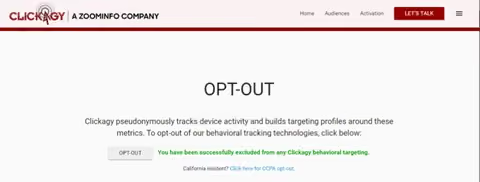
Press opt-out Button

You will get the following message:
2. Website:
You can do this by accessing their "Do Not Sell My Personal Information" webpage on their website or through https://www.clickagy.com/ccpa/
3. Email:
You can write to them at ccpa@clickagy.com
4. Call Them:
You can request Clickagy to opt-out by calling them at (877) 678-4577.
They may ask you to do some steps, such as
filling out their web form
providing them with specific details to be used solely with the goal of establishing your identification in order to validate your desire to delete or remove information.
How to Opt-Out, Delete, Or Make Privacy Requests From Optin Contacts?
Company Overview
Optin Contacts is a company that provides targeted email lists to businesses. Their email lists are verified and accurate, offering a quality and cost-effective email database that can increase your ROI. They also offer digital services, including SEO, online, email, and social media marketing. Their services are affordable and immediate, and they have the right digital marketing solution for your business.
Optin Contacts employees are dedicated to providing clients with the highest rate of return on investment (ROI) possible. They focus on presenting clients with appropriate mailing and email lists and business intelligence to help them maximize their sales and lead generation.
Their databases are updated quarterly and are comprised of the latest information, with the least amount of redundancy. This allows the clients to streamline their sales forces, configure price quotes, and drive bigger deals faster.
Optin Contacts has enabled various organizations to accelerate and maximize their lead-to-money process. The company equips its clients with a complete suite of solutions that identify the right leads, ensure proper territory and quota distribution, and automate sales forces. Their team is committed to providing our clients with the highest customer service and support possible.
Type Of Consumer Data Collected?
The types of consumer data collected by Optin Contacts include:
Contact information (name, address, phone number, email address)
Demographic information (age, gender, income, education level)
Interests and preferences (product/service interests, purchasing habits)
Behavioral data (web browsing history, search history, social media activity)
How Is Consumer Data Collected?
Optin Contacts collects consumer data through a variety of methods, including:
Third-Party Data Providers:
Optin Contacts buys consumer data from third-party data providers like Experian, Acxiom, and Epsilon. These companies collect consumer data from various sources, including public records, surveys, and loyalty programs.
Website Cookies and Tracking:
Cookies are small pieces of code placed on your computer by the websites you visit. They are used to track your web browsing behavior and can also be used to collect personal information.
Social Media:
Facebook, Twitter, and LinkedIn allow businesses to collect data about users through the use of cookies, tracking pixels, and other methods.
How Is Consumer Data Used?
The company uses the data for the following purposes:
Helping businesses better understand their customers and what they want
Improving marketing efforts by targeting consumers more effectively
Increasing sales by tailoring product and service offerings to specific consumer groups
Decreasing costs by reducing wasted marketing spend on consumers who are not interested in what a business has to offer
Do Optin Contacts Share Consumer Data?
Optin Contacts shares data with affiliates within reasonable limits to provide services, with business partners, vendors/suppliers, and sub-contractors for the performance of a contract, and with analytics and search engine providers to improve digital presence. In special circumstances, data may be disclosed to other third parties, such as selling or buying business assets or a business acquisition by a third party.
The Rights Given Under CCPA, FCRA, GDPR, and DPA
These laws give consumers certain rights concerning their data. These include the right to know what personal data is being collected about them, the right to have that data erased, the right to object to its use, and the right to opt out of having it sold.
Optin Contacts allows consumers to exercise their rights under CCPA, FCRA, GDPR, and DPA. To do so, read the section below.
How To Request Deletion Of Your Data?
If you are interested in exercising any of the rights listed above, please email the company at info@optincontacts.com or write to them at the following address:
Optin Contacts LLC, 1
7 State Street,
Suite 4000,
New York, NY 10004,
United States
Phone: (832) 380-3499
While submitting a request, you will need to provide the following information:
Your name
Your email address
The personal data you wish to have deleted
In some cases, Optin Contacts may need additional information from you to verify your identity and process your request.
Optin Contacts will respond to your request within 30 days. Please note that not all requests will be granted. For example, Optin Contacts may decline a request for deletion if the data in question is necessary for the company to fulfill a legal obligation or if it is being used for research purposes.

How to Opt-Out, Delete, Or Make Privacy Requests From NetWise?
Company Overview
NetWise is a company that provides industry-leading platform tools, education, and information to help businesses make strategic decisions and grow efficiently. They believe that clean, compliant data is at the heart of what sets them apart and that keeping pace with technology is second in importance only to information.
NetWise team has a wealth of experience in data management and technology and is passionate about helping businesses use data effectively. Their platform allows companies to collect, cleanse, enrich, and manage compliance requirements. In addition, their education offerings provide insights into to best use of data to drive business growth.
Their information services keep businesses up-to-date on the latest data trends. All of these offerings help enterprises make strategic decisions and grow efficiently. NetWise is constantly innovating to ensure they provide the best possible platform for their customers. They have recently released a new set of features that streamline data management and improve compliance.
These features include a centralized repository for all business data, automated data cleansing and enrichment, and real-time reporting and alerts. With these new capabilities, NetWise is helping businesses take control of their data and use it to drive growth.
Type Of Consumer Data Collected?
NetWise collects a variety of data from businesses, including
Contact Information:
Names, titles, addresses, phone numbers, and email addresses.
Demographic Information:
Job function, industry, company size, and revenue.
Firmographic Information:
Business type, location, and website.
Technographic Information:
Technology used by the business, including software and hardware.
Behavioral Data:
This includes data on what features are used most often, what content is consumed, and how NetWise products are being used to drive growth.
Financial data:
Invoices, payment information, and contract value.
NetWise takes data security and privacy seriously. They have implemented various technical and physical safeguards to protect customer data from unauthorized access, use, or disclosure. They also require employees to undergo regular training on best practices for data security and privacy.
How Is Consumer Data Collected?
NetWise collects data from businesses in a variety of ways, including
Through Business Interactions:
NetWise gathers data from businesses when interacting with the company, such as when they create an account, purchase a product or service, or participate in educational offerings.
From Third-Party Sources:
NetWise also collects data from third-party sources, such as market research firms, business directories, and public records.
Through Cookies and Other Tracking Technologies:
NetWise uses cookies and other tracking technologies to collect data about how businesses use their website and products. This includes information on what pages are visited most often, what features are used most often, and what content is consumed.
How Is Consumer Data Used?
NetWise uses customer data to provide businesses with the services they need to grow efficiently. This includes using data to
Collect, cleanse, and enrich business data:
NetWise uses customer data to collect, edit, and improve business data.
Manage compliance requirements:
NetWise also uses customer data to help businesses manage compliance requirements. This includes ensuring that companies have the necessary documentation and processes in place to comply with GDPR etc.
Provide insights into how to best use data:
In addition, NetWise uses customer data to provide insights into how businesses can improve their marketing strategies and boost their sales.
The Rights Given Under CCPA, FCRA, GDPR, and DPA
NetWise gives businesses the right to:
Access their data: Companies have the right to access the data NetWise has collected about them.
Delete their data: Companies have the right to delete the data NetWise has collected about them.
Opt out of data collection: Companies have the right to opt out of data collection.
Get information on how their data is used: Businesses have the right to get information on how their data is used.
How To Request Deletion Of Your Data?
Filling out the deletion request form: businesses and consumers can fill out the form available on NetWise's website.
Customer support: businesses and consumers can contact NetWise through the email address privacy@netwisedata.com or at the customer support number at 866-203-7797 and ask to speak with someone about deleting their data.
If you want to remove your personal information from NetWise products, you can fill out this form.

How to Opt-Out, Delete, Or Make Privacy Requests From Otonomo?
Company Overview
Otonomo is a company that provides data services to app and service companies to enable advanced driver solutions. Their platform reshapes, harmonizes, enriches, and secures connected car data so the network can deliver these solutions.
Otonomo is dedicated to providing solutions that adhere to the strictest privacy and security standards. Their commitment is to create a mobility ecosystem that uses data to make every driving experience truly rewarding. Their vision is to enable a world of environmentally-friendly cities that run more efficiently.
Otonomo's smart city solutions provide deeper insight into congestion and pollution levels, transportation system planning, and emissions management. By incorporating data from vehicles into their solutions, cities can improve response times, reduce congestion, decrease property damage, and save lives.
In addition, Otonomo's fleet management solutions automate driver tasks such as parking or road usage tax payments or hours of service tracking for compliance. Otonomo's safety and emergency solutions improve response times and identify problem areas.
Otonomo offers a range of services that use data from connected cars to improve various aspects of transportation. These services include:
Mapping and planning solutions use aggregate, blurred data to develop HD maps and make intelligent decisions about commercial sites.
EV charging services that optimize energy distribution and make EVs more convenient to own.
Innovative insurance services use connected car data to increase profitability and create better policyholder experiences.
Location intelligence services gain valuable market research input to understand traffic around commercial centers.
Remote diagnostics services that monitor the health of the entire fleet in real time.
Type of Consumer Data Collected
Otonomo collects a variety of consumer data, including traffic/session information, login information, e-mail addresses, passwords, access device information, and browser information. Otonomo also collects activity data, such as login and log-out times, session durations, content uploaded and downloaded, web page visits, and geo-location data.
How Does Otonomo Use Consumer Data?
Otonomo uses consumer data to:
Improve urban planning
Traffic flow management
Parking management, automated road tolls, and car-design improvements
Otonomo also uses data for feedback for car research and development optimization, usage-based insurance, vehicle monitoring and theft protection, collision warning, and real-time weather and hazard notifications.
In addition, Otonomo uses consumer data to improve the quality of the services offered on the platform. This includes reducing traffic congestion, optimizing routing, and enhancing safety. Otonomo also uses data to understand better how people use cars and transportation services. This understanding helps to create new services and features that meet customer needs.
Does Otonomo Share Consumer Data?
Otonomo shares consumer data with companies that help it to improve the Site and Service, including but not limited to: analytics, data hosting, backup, business intelligence services, customer relations, cyber security, mailing, and other relevant services. They also share consumer data with their affiliate entities.
Otonomo also shares consumer data with its marketplace partners. These partners include smart cities, automotive suppliers, insurance companies, safety and emergency service providers, etc. By partnering with these organizations, Otonomo can provide a comprehensive platform that enables safe and efficient data sharing among all stakeholders.
The Rights Given Under CCPA, FCRA, GDPR, and DPA
The California Consumer Privacy Act (CCPA), the Fair Credit Reporting Act (FCRA), the General Data Protection Regulation (GDPR), and the Data Protection Act (DPA) grant individuals certain rights with respect to their personal data.
Under these laws, individuals have the right to:
Know what personal information is being collected about them.
Access their personal information.
Request that their personal information be deleted.
Opt-out of the sale of their personal information.
Request that businesses stop collecting or using their personal information.
File a complaint if they believe their rights have been violated.
How to Request Deletion of Your Data?
To request deletion of your data, go to the Otonomo Driver Privacy Rights Portal. Complete the short form on the right side and click submit. The team might take a few days to review your request and verify your identity, after which your data will be removed from all of Otonomo's databases.
Plus, this portal also enables you to:
Request for review of your stored personal data
Request for deletion of your data
Be able to manage who your data is being shared with
Request to opt-out
Alternatively, you can also contact them by:
Mailing them at privacy@Otonomo.io
Mailing address: 16 Abba Eban Blvd. Herzeliya Pituach, Israel
Using the Live Chat on their website

How to Opt-Out, Delete, Or Make Privacy Requests From Data Marketers Group?
Company Overview
Data Marketers Group is a data-driven marketing service provider that was founded in 2010 to empower businesses. The company has over 50 million accurate and verified B2B records and offers a wide range of email and mailing lists.
Data Marketers Group has a wide range of email and mailing lists that can help marketers reach their target audience. The company has over 50 million accurate and verified records, which can be used to create targeted marketing campaigns.
With its specialized and effective data-driven solutions, Data Marketers Group aims to offer businesses the right tools that help them explore every marketing opportunity.
Services Provided
Some of the notable services offered by Data Marketers Group include:
Accurate and verified B2B records
Wide range of email and mailing lists
Data appending
Cleansing
Reselling
Profiling
Data Marketers Group can help you take your business to the next level with accurate and verified data, affordable prices, and flexible payment options. The Data marketers group aims to provide high-quality leads for technology users, healthcare professionals, finance industry professionals, and other global audiences. Their services help marketers to drive multichannel campaigns that result in quality leads and conversions.
The team at Data Marketers Group has a wealth of experience in providing accurate lists for various industries. Their experience and knowledge ensure that their clients receive the best results from their marketing campaigns.
Type Of Consumer Data Collected
Data Marketers Group collects the following types of consumer data:
Name
Designation
Company name
Postal address
Email address
Contact information
Work location
How Is Consumer Data Collected?
There are several ways that consumer data is collected. Some of the most common methods include:
From their Website:
They can collect data from people who visit their website through forms, cookies, and other tracking methods.
Surveys:
Consumer surveys are one of the most common methods of collecting consumer data. Surveys can be conducted online, over the phone, or in person.
Data mining:
Data mining is a process that involves extracting data from a variety of sources. This data can create marketing lists, target consumers, and track consumer behavior.
Through social media and public databases, they are able to compile consumer data that is accurate and up-to-date. This allows them to create targeted marketing campaigns that are more likely to result in conversions.
Why Is Consumer Data Used?
Consumer data is used for a variety of purposes, including:
To deliver the products and services that have been ordered or requested.
Send communications about products, services, promotions, or events that interest you.
To customize and personalize the content and experience on our website and in our communications.
To generate aggregated reports about website usage and activity.
To conduct research and analysis about consumer trends, preferences, and behavior.
To detect, investigate, and prevent fraudulent or illegal activity.
The Rights Given Under CCPA, FCRA, GDPR, and DPA
The Data Marketers Group is committed to protecting the privacy of our consumers and providing them with information about their data. Under the CCPA, FCRA, GDPR, and DPA, consumers have the right to:
Access their data:
Consumers have the right to access the personal information that we have collected about them.
Delete their data:
Consumers have the right to delete their personal information from our records.
Opt out of Marketing Communications:
Consumers have the right to opt-out of receiving marketing communications from them.
Do not sell:
Consumers can opt to have their personal information sold to third parties.
To exercise any of these rights per the law and the company's privacy policy, you can refer to them below.
How To Request Deletion Of Your Data?
If you want to exercise any right given by the law, you can use one of the three methods given below:
Email them at info@datamarketersgroup.com
Call at 914 - 288 - 5888
Mail your query to them at the following mailing address
1330 Avenue of the Americas,
Suite 23A,
New York City,
NY 10019
Make sure to write a suitable subject line about the right you want to exercise and write complete information in the email. The company will verify your identity before processing your request as per the law. Once verified, they will delete your data from their database within a specific timeframe.
How to Opt-Out, Delete, Or Make Privacy Requests From Mailing Data Solutions?
Company Overview
Mailing Data Solutions is a data provider that understands the importance of quality data. With over 13 years of combined experience, their team is dedicated to providing clients with accurate, up-to-date, and high-quality data. They have employed over 170 agents who make over 500,000 verification calls monthly to ensure accuracy.
Their data is updated monthly, and they offer a 100% satisfaction guarantee. Mailing Data Solutions is the perfect partner for your next direct mail campaign. Their data is also compatible with all major CRM software programs. In addition to providing quality data, they offer post-campaign analysis to help clients identify missed opportunities.
The company's commitment to customer service transcends customer size - both their self-serve and enterprise products are designed and priced for accessibility. Their data has helped their clients increase their lead-to-opportunity conversion by 28%. Their data is up to 23% more accurate than other commercial data sources.
Services Provided
Mailing data solutions provide various services that will help boost your company's growth. They have a team of experts who study each case individually and provide solutions that benefit their clients. The services which they provide are as follows:
Mailing Lists:
Mailing lists will help you create a list of your target audience according to your preferences. It includes:
Industry Mailing Lists
Healthcare Email Lists
Technology Users Email Lists
Executive Email Lists
Geo-Targeted Email Lists
Business Database:
They have a database of businesses that you can use for your marketing efforts. This includes all the business-related email lists you can use to target your campaigns.
They also provide data services such as email marketing campaigns and data cleansing. This ensures that your data is accurate and up to date. Additionally, they provide data profiling services too. This helps you understand your customers better and target them more effectively.
Type Of Consumer Data Collected
Some examples of the type of consumer data that Mailing Data Solutions collects are:
Name
Address
Phone Number
Email Address
Age
Gender
Income Level
Occupation
Interests/Hobbies
Cookies and Other Tracking Technologies
Mailing Data Solutions uses cookies and other tracking technologies to collect information about your activity on their site. This helps them understand how you use their site and how they can improve your experience.
How Is Consumer Data Collected?
Mailing Data Solutions only collects the personal information necessary to provide their services. This includes information such as your name, address, and contact information. They do not sell or share this information with any third-party companies. They only share your data per their policy with verified businesses, using it to enhance their marketing. Your personal information is only used to provide you with their services.
There are a few ways in which Mailing Data Solutions collects consumer data. This includes:
Through their Website:
When you visit their website, they use cookies and other tracking technologies to collect information about your activity.
Through Third-Party Data Providers:
Mailing Data Solutions works with third-party data providers to supplement their collected data. This helps them provide more comprehensive services to their clients.
The Rights Given Under CCPA, FCRA, GDPR, and DPA
The CCPA, FCRA, GDPR, and DPA all give consumers certain rights regarding their data. These rights include the right to know what personal data is being collected about you, the right to access this data, and the right to correct any inaccurate data. The right to delete your data and opt-out of any data collection you do not want to participate in. You also have the right to file a complaint if you feel that your rights have been violated.
How To Request Deletion Of Your Data?
If you want to request deletion of your data or if you want to exercise your rights as described above can email mailing data solutions at info@mailingdatasolutions.com.
Make sure to write a suitable subject line about the right you want to exercise and write complete information in the email. The company will verify your identity before processing your request as per the law. Once verified, they will delete your data from their database within a specific timeframe.
You can also contact them at +1 (786) 408 8148 or mail them at their address:
228 Park Ave S #30133
New York, NY 10003-1502
USA

How to Opt-Out, Delete, or Make Privacy Requests From Data Partners
Data Partners
Company Overview
Data Partners is a Florida-based company providing clients with direct marketing services to market their products and services effectively. In addition, the company offers specialized marketing products for the cable telecom industry. Some of Data Partners’ clients include big corporations such as Atlantic Broadband, Comcast, and the United States Postal Service. View the full list of their clients by clicking on the link below.
Data Partners’ List of Clients
Data Partners and Your Personal Information
Do you know Data Partners’ policies on the management of consumer data? Since data is a valuable form of currency among corporations, it’s best that you educate yourself on how this company intends to manage your Personal Information. Find out when you can access the company’s Privacy Policy by clicking on the link below. The Policy was last updated on October 31, 2021.
If the link above doesn’t work, click on the “Privacy Policy” link found on the website’s Footer (the bottom section of the website) as shown in the image below.

Read Section III of the Privacy Policy titled “Information Collection and Use” to learn about the different kinds of Information that Data Partners collects directly from you and third-party sources and how they use such information to attain their goals. Sub-section E of the same Section titled “Information we Do NOT Collect, Use, or Sell” declares a list of different categories of Information that they claim to not sell or share with others.
Corporations purchasing data to promote their businesses are always attracted to companies having access to huge databases of consumer data. Therefore, such companies could be selling consumer data, including your Personal Information, for the right cost. Exercise your Data Privacy Rights and prevent them from selling your Personal Information; you can go even further and request that they delete your information from their databases. Learn how to prevent the sale of your Information when you read the remainder of the article.
Opting Out and Deleting Your Consumer Information
Data Partners facilitates any request from consumers desiring to opt out of the company’s databases; however, it only grants Californian residents the option to request the deletion of their Personal Information under the California Consumer Privacy Act (“CCPA”). Please note that you may be asked to proceed through an identity verification process before your request can be fulfilled. According to Data Partners, such requests usually take up to 20 business days.
Opting OutOnline Form
Fill out and submit an Online Form in the “OPT OUT REQUEST” page as shown in the image below as of August 2022.

Click on the link below to access the “OPT OUT REQUEST” page as shown in the image above.
Data Partners’ “OPT OUT REQUEST” Online Form
Send Data Partners an email requesting to opt out of their databases. Ensure that you include your request, full name, full address, and contact number(s). The email address to which to send such a request is optout@datapartners.com.
Telephone
Make a phone call to Data Partners requesting to opt out of their databases. The contact number is 866-423-1818.
Deletion of Personal Information (Californian Residents)Online Form
Fill out and submit an Online Form in the “CCPA DELETE INFO REQUEST” page as shown in the image below as of August 2022.

Click on the link below to access the “CCPA DELETE INFO REQUEST” page, as shown in the image above.
Data Partners’ “CCPA DELETE INFO REQUEST” Online Form
Send Data Partners an email requesting that the company delete your Personal Information. Ensure that you include your request, full name, full address, and contact number(s). The email address to which to send such a request is deletemyinfo@datapartners.com.
Telephone
Make a phone call to Data Partners requesting that the company deletes your Personal Information. The contact number is 866-423-1818.
Freedom Exercised
If you’ve opted out of Data Partners’ databases or requested to have your Personal Information deleted, you’ve lowered the chances of such Information being publicized as a result of cyber-attacks. Great job defending your Privacy and reducing your digital footprint!

How to Opt-Out, Delete, Or Make Privacy Requests From KBMG?
Company Overview
KBMG is a provider of knowledge-based marketing solutions that aid companies in making better use of their data for marketing purposes. They gather, connect, and make necessary amendments to convert the data into a strategic marketing asset.
KBMG has a team of analysts, marketers, and strategists who help businesses discern their target audience and understand how they can better market to them. Overall, KBMG is focused on assisting corporations in making the most out of their marketing data.
The advanced analytics and insights from KBMG influence marketing messages and content. They collaborate with marketers to integrate, manage, analyze, and improve their data to interact with clients and prospects more successfully. KBMG also uses its experience and expertise to deliver marketing services for various industries, including healthcare, retail, technology, and more.
KBMG's services are designed to increase marketing ROI, whether it be through improved customer engagement, increased leads and sales, or more efficient use of marketing budgets. KBMG has a proven track record of helping companies achieve their marketing goals.
In addition to content services, KMBG offers a wide range of tools for managing customer data. These include software for segmentation, campaign management, lead nurturing, and reporting. The company also has a team of certified professionals who help with the implementation and support of these tools.
Their services are designed to improve marketing messages and content and increase conversions through enhanced customer data management. KBMG's holistic approach to marketing ensures that its clients receive the best possible return on investment.
Type Of User Data Collected
The KBMG website does not collect the personal data of visitors and does not download cookies. However, some data collected by the company includes:
Anonymous:
browser information, cookie data, date/time, hardware/software type, internet service provider, page views
Pseudonymous:
IP address, location-based data
PII: EU- IP address
How Does KBMG Use Consumer Data?
KBMG uses these details to identify patterns, manage the website, monitor user behavior, and compile demographic data. There is no connection between IP addresses, similar data, or personally identifying information.
The company uses consumer data for the following purposes:
To provide, operate, and improve the website:
This includes using data to administer the website and troubleshoot issues.
To deliver Content and Advertisements:
KBMG may use user data to provide personalized content and targeted advertisements.
For Research and Development:
KBMG uses consumer data to test new features and products. This helps them understand how users react to changes and identify areas of improvement.
How Long Does KBMG Retain Your Data?
They will keep your information for as long as it takes to complete the tasks associated with those purposes, including satisfying any reporting or legal obligations.
KBMG considers things before deciding the period of your data retention. These include:
The amount and sensitivity of the personal data.
The risk of harm from unauthorized use or disclosure of the data.
The applicable legal requirements.
The Rights Given Under CCPA, FCRA, GDPR, and DPA
You have certain rights concerning your data under data protection law. Subject to certain conditions and exceptions, you have the right to:
Obtain your data access:
This allows you to get a copy of your data.
Requesting the personal data that is to be corrected:
This permits you to request the correction of any missing or incorrect information the firm may have about you.
Request erasure of your data:
This gives you the option to request that we delete or otherwise dispose of personal data.
Object to processing of your data:
If you feel your rights are being violated, you can make a request.
How To Request Deletion Of Your Data?
Request Access To The Information Collected: You can request the information they have collected by sending an email to dpo@conexancemd.com. Or you can fill out this form.
Request Deletion Of Your Data: You can also request deletion of your data by emailing dpo@conexancemd.com. Or directly by filling this form and providing some data.
Do Not Sell Your Info: You can request that your data not be sold by filling out the form here.
This Privacy Policy, don't hesitate to get in touch with them at:
Email: dpo@kbmgroup.com
KBMG will respond within 45 days from the date they receive your request. If you have any questions about their data protection policy or how they process your data, please call them at the toll-free number +1 833 296 0825.
If you still have concerns about their privacy policy and marketing strategies, you can fill out the inquiry form available here.

How to Opt-Out, Delete, Or Make Privacy Requests From John Doe?
Company Overview
John Doe is a data broker that posts personal information on the internet. John Doe is a people-search website that displays home addresses, phone numbers, links to relatives and neighbors, etc. John Doe is unique because he sells this information to the public.
John Doe has been in business for years and has built a reputation as the most reliable and accurate source of online personal data. This site has become a go-to source for anyone looking to find out more about someone.
John Doe's business model is simple: the company charges a monthly subscription fee, and subscribers have access to all the personal data he has collected. They don't just sell this information - they make it freely available to anyone who wants it.
This has made them a top-rated site among those interested in finding out more about people, and this website is now one of the most well-known people-search sites on the internet. What makes John Doe so controversial is their way of collecting data. The company doesn't buy it from public records - they also use a variety of underhanded tactics to get it.
These practices have led many people to question the ethics of John Doe's business and whether or not it is legal. Despite the controversy, John Doe remains a popular website, and its popularity is only increasing as more and more people become interested in finding out more about others. If you're looking for someone's data, there's a good chance you'll find it on John Doe.
Type Of Consumer Data Collected
John Doe collects a variety of different types of consumer data, including:
Name
Home addresses
Phone numbers
Links to relatives and neighbors
Personal information such as date of birth, social security number, etc.
How Does John Doe Collect This Data?
There are a few different ways that John Doe collects consumer data, including:
Buying it from public records
Accessing people's computers and managing their data
Purchasing data from people who have stolen it from other sources.
Questionnaires, surveys, and interviews
Sharing Of Consumer Data
John doe is a data broker company, and its mode of revenue is sharing of data. Also, they sell their information products to other data brokers and marketing firms. However, it is unclear how well they protect the confidentiality of the people whose data they collect and sell.
They may share your personal information with their affiliates and business partners according to their privacy policy.
Some people have also accused them of misrepresenting how they use and collect consumer data. For example, they claimed that they only collect "anonymous" data when collecting personally identifiable information. In addition, there have been complaints that John Doe's products are inaccurate and out-of-date.
Risks Of Consumer Data Collection
The risks of having your data collected by John Doe include:
Identity theft
Fraudulent charges on your credit card or bank account
Spam emails and junk mail
Unwanted telemarketing calls
Targeted advertising
The Rights Given Under CCPA, FCRA, GDPR, and DPA
The California Consumer Privacy Act (CCPA), Fair Credit Reporting Act (FCRA), General Data Protection Regulation (GDPR), and Data Protection Act (DPA) are all laws that protect consumer data.
These laws give consumers the right to know what personal information is being collected about them, the right to delete their personal information, and the right to opt-out of having their personal information sold. John Doe is subject to all of these laws, and they must comply with them to operate legally.
How To Request Deletion Of Your Data?
Opting out of having your personal information sold, deleting your personal information, and asking John Doe to stop collecting it is simple, and you can do it in a few steps.
Go to https://johndoe.com and search for your name in the listing; once you have found your name, copy the URL and paste it onto https://johndoe.com/optout_request. Fill out the other necessary information and proceed next. The company will verify your information and process your request within 72 hours.
Remember, the opt-out portal will ask for your ID. Do not forget to blur your image and signature, as this is your identity, and you should keep it safe.

How to Opt-Out, Delete, Or Make Privacy Requests From InfoPay?
Company Overview
InfoPay is a company that specializes in helping people to manage and protect their personal information. InfoPay allows people to manage and protect their data. InfoPay has an extensive database of information to help its clients find what they need. InfoPay also has unique expertise in organizing, indexing, and sorting data.
This allows InfoPay to give its clients the tools to keep their personal information safe. InfoPay is committed to helping its clients stay informed about their data and making it easy. InfoPay also provides a variety of ways for its clients to keep their personal information safe.
InfoPay's proprietary technology and expertise make aggregating, indexing, verifying, searching & monitoring data accessible and on demand. While other companies may offer similar services, InfoPay is unique in its commitment to customer service and privacy.
InfoPay has a dedicated team of customer service representatives available to answer any questions you may have about your data or how to keep it safe. InfoPay also takes privacy seriously and has taken steps to protect your personal information.
Services Provided
Services offered by InfoPay include access to public records, identity & credit monitoring, and vehicle reports. All these services are designed to help people protect their personal information and stay informed about changes or breaches that could affect them.
They can provide this scale and support because they have a passionate, knowledgeable team that utilizes the latest technologies. From their innovative search platform to the mobile app that allows you to take Info pay with you wherever you go, they strive to make finding the public records you need as easy and efficient as possible.
Type Of Consumer Data Collected
The company collects the following types of data from consumers:
Personal information, such as name, email address, mailing address, and phone number
IP address
Web browser type and operating system
Referring website addresses
Information about actions taken on our website, such as page views and site navigation patterns
How Does InfoPay Collect Data?
InfoPay collects consumer data in the following ways:
You voluntarily provide it through forms, such as when you create an account, etc.
Through cookies and other tracking technologies, as described in more detail in their Cookie Policy.
Third-party sources include data providers, social media platforms, and public records.
How does InfoPay Use Consumer Data?
InfoPay uses consumer data for the following purposes:
To provide you with the products or services you request
To send you marketing communications
To contact you about your account or transactions.
For research and development purposes
Calculate the quantity of our readership and usage trends
Keeping a record of your preferences
Accelerate your search
Sharing Of Consumer Data
The company may share consumer data with the following types of third parties:
Service providers help us with business operations, such as website hosting, data analysis, payment processing, customer service, and marketing.
Business partners, such as companies that offer joint promotions or co-branded products or services.
Advertising networks and social media
The Rights Given Under CCPA, FCRA, GDPR, and DPA
The following rights are provided under various consumer protection laws:
The right to be informed about the personal data being gathered about you
The right to be informed of how one's data is being utilized
The right to know who is receiving that personal information
The right to protest the sale of your data
The right to request the deletion of your data
The right not to be subjected to discrimination for exercising any of the above rights
How To Request Deletion Of Your Data?
You can send them a verified consumer request to exercise your access, data portability, and deletion rights by contacting InfoPay using one of the following methods:
Sending an email to privacy@infopay.com
Dialing: (800) 309-9351
Only you or someone you have authorized to act on your behalf and registered with the California Secretary of State may submit a verifiable consumer request relating to your personal information. A valid consumer request may also be made for your underage child.
You can click here to contact InfoPay or send them a letter if you have any questions or complaints regarding their privacy statement or services.
InfoPay.com
28 Atlantic Ave Suite 227
Boston, MA 02110

How to Opt-Out, Delete, Or Make Privacy Requests From InfoDepots?
Company Overview
InfoDepots is a data support provider that aims to be the go-to marketing tool for businesses of all sizes. With over 160 specialists on staff, They offer unmatched business intelligence and customer outreach capabilities.
Their team unearths data from all corners of the globe, making their services the most comprehensive industry. The company is passionate about customer satisfaction and works tirelessly to provide businesses with the tools they need to succeed.
InfoDepots understand that having access to accurate and current information is critical for success in any business. That's why they offer unmatched business intelligence and customer outreach capabilities. InfoDepots goes above and beyond to ensure their clients have everything they need to succeed.
Their services simplify complex data and make it easier for businesses to reach their target audiences. They offer a variety of data lists that can be customized to meet each company's unique needs. They also maintain their database so businesses can achieve their marketing goals.
InfoDepots is committed to helping businesses overcome their marketing challenges and realize their full potential. Their goal is to provide businesses with the support they need to grow and thrive in today's competitive marketplace.
Services Provided
At InfoDepots, they have 280+ million email databases alongside points of interest of email addresses, names, postal locations, SIC codes, etc. InfoDepots have a group of specialists who are always prepared to support you with Email Marketing services.
Email marketing is a terrific method to stay in touch with your clients and keep them informed about your latest products and services. But it can be challenging. That's where InfoDepots comes in. They can help you create a successful email marketing campaign to reach your target audience and help you achieve your business goals.
InfoDepots has a team of experienced professionals who can help you with every aspect of your marketing campaign, from creating beautiful email templates to designing custom landing pages and whatnot. They'll ensure your campaign is successful.
Type Of Consumer Data Collected
The type of data that InfoDepots collects includes:
Personal Data:
They collect personal data from you when you use their Service. This may include your name, email address, phone number, and other information that can be used to contact or identify you.
Usage Data:
This may include information such as your device's browser version, IP address, browser type, unique device identifiers, etc.3Tracking Technologies and Cookies: InfoDepots use cookies and similar tracking technologies to track the activity on their Service and store certain information.
How Do InfoDepots Use Consumer Data?
Indepots may use Personal Data for the following purposes:
To provide and maintain their service
To notify you about changes
To provide customer support
To detect, prevent, and address technical issues
To gather analysis or valuable information
InfoDepots will take all necessary steps to ensure that your data is treated securely. However, the company may share your data as per policy for
Security of your data
Detailed information on the processing of your data
Analytics
Advertising
The Rights Given Under CCPA, FCRA, GDPR, and DPA
You have the following rights under different legislations:
The right to be informed
The right of access
The right to object
The right to erasure
The right to rectification
The right to restrict processing
The right to data portability
The right not to be subjected to automated decision
Under the CCPA, FCPA, GDPR, and DPA, you reserve all these rights and may exercise them per the law.
How To Request Deletion Of Your Data?
If you wish to delete your data, you may contact the company at the email address info@infodepots.com. The company will take all steps necessary to delete your data from their system. However, it may take up to a month to process your request. Do not forget to mention the right you want to exercise in the subject line. The company holds the right to verify your identity before processing your request.
You may also unsubscribe from InfoDepots' marketing communications by clicking on the "unsubscribe" link in the email or by contacting the company at the email address mentioned above.
If you have any queries regarding the privacy policy, you can call them directly.
Telephone:
+1 844-822-2600
Or write to them at this address:
260 Madison Avenue, 8th Floor Manhattan, NY 10016
Or fill out this form.

How to Opt-Out, Delete, or Make Privacy Requests From 700Credit
700Credit
Company Overview
Located in the state of Michigan, 700Credit is a company providing credit reporting, compliance vendor management and soft pull products to Automotive, RV, Powersports and Marine dealerships within the US.
700Credit and Your Personal Information
Spend some time becoming familiar with 700Credit’s Privacy Policy to discover how they intend to handle consumer information. This is increasingly important in today’s world because data has become a valuable form of currency for corporations. Hence, it’s about time you learn more about their policies and safeguard your Privacy. Click on the link below to open 700Credit’s Privacy Policy from their website and peruse the document at your own pace. Unfortunately, the company hasn’t provided an amendment date for the policy.
If the link above doesn’t work, click on the “Privacy Policy” link found on the website’s Footer (the bottom section of the website) as shown in the image below.

The Privacy Policy boldly claims that 700Credit does not sell or share your Personal Information which you provided to them, except for the purposes for which you agreed to share it. Yet, in the section of the document titled: “How is information collected, used, and disclosed?”, it states that 700Credit may share Information you voluntarily provided to them with "trustworthy business partners".
Companies with access to huge databases of consumer information sometimes sell that data to larger businesses and corporations for profit. Fortunately, the introduction of the California Consumer Privacy Act ("CCPA") and other similar laws gives you the right to request the deletion of your Personal Information from the company’s databases if you’re not comfortable with their handling of data. Let’s show you how it’s done.
Deleting Your Personal Information
As indicated in their Privacy Policy, 700Credit recognizes the rights granted to consumers by the CCPA to request to have their Personal Information deleted from the company’s databases. Therefore, 700Credit facilitates any such requests from a Californian resident; however, the company doesn’t seem to facilitate the same requests from residents of any other state. Nevertheless, if you’re a Californian resident, you can make the request using one of the following means below. Please note that there’s no reference to opting out of 700Credit’s data-selling campaigns.
Send 700Credit an email requesting to have your Personal Information deleted. The email address to send such a request is ccpa@700credit.com.
Compose a letter addressed to 700Credit requesting to have your Personal Information deleted. Mail the letter to the following address:
700Credit, PO Box 101015, Pasadena, CA
Freedom Exercised
When you requested to have your personal information deleted from 700Credit’s databases, you made a great decision to protect your privacy. Experience the feeling of relief knowing that the risk of your Information being leaked by hackers is greatly reduced.
How to Opt-Out, Delete, or Make Privacy Requests From Core Logic
CoreLogic
Company Overview
CoreLogic is a California-based company that provides business intelligence and data analytics for the real estate industry. Using the largest property database in the nation, CoreLogic supports real estate professionals, financial institutions, insurance carriers, government agencies, and prospective property owners in making the best decisions. They offer detailed property information, including virtual property view, property value estimation, rental income projection, neighborhood insights, risk management, and flood risk analysis. In addition, CoreLogic identifies the property’s exposure to various risks, hazards, and natural disasters to assist insurance companies in determining the proper level of coverage required. CoreLogic worked closely together with Symbility Solutions, which led to CoreLogic’s acquisition of the company in 2018 after six solid years of partnership.
CoreLogic and Your Personal Information
Are you aware that data is the new currency in today’s world? That’s why it’s crucial that you understand how companies managing tons of data, like CoreLogic, handle consumer information. Learn more by reading CoreLogic’s Privacy Policy, which can be accessed directly from the company’s website. Click on the link below to open the Privacy document which was last updated on December 16, 2021.
If the link above doesn’t work, click on the “Privacy Policy” link found on the website’s Footer (the bottom section of the webpage) as shown in the image below.

According to Section 2 within the Privacy Policy titled: “Collection, Use, and Sharing of Data” and Section 13 titled: “Annex – Symbility Property Applications”, CoreLogic states that both companies may share (and potentially sell) your Personal Information to other companies for various purposes.
CoreLogic has access to loads of information on consumers collected either directly or indirectly. With the possession of so much data on individuals, companies become targets of corporations making huge profits from data. Likewise, it's pretty much common for such companies to collect and sell consumer data to businesses willing to pay the price. If you’re not content with the use and sale of your Personal Information, most companies have agreed to stop the sale of your Information at your request. Luckily, with the law on our side, you can request that CoreLogic prohibits the sale of your Personal Information and even delete that Information from their databases.
Opting Out and Deleting Your Personal Information
CoreLogic organized a simple process for persons looking to opt out of the company’s data-selling campaigns or have their personal information deleted from the company’s databases. We should be thankful for the existence of current US laws that grant us the right to exercise control over the Information collected by companies. You can make the request via communication with the companies using one of the following means below. Please remember that you have to make a separate request to Symbility Solutions.
Send both CoreLogic and Symbility Solutions an email requesting to stop the sale of your Personal Information or request to have your Information deleted. The email addresses to send the request are:
CoreLogic:
Symbility Solutions:
Compose a letter addressed to Symbility Solutions requesting to stop the sale of your Personal Information or request to have your Information deleted. Mail the letter to the following address:
Symbility Solutions, Inc., Data Protection Officer, 30 Adelaide East Street, 5th FL, Toronto, ON M5C 3G6, Canada
Freedom Exercised
Deleting your Personal Information from companies like CoreLogic certainly protects your privacy as you exercise the rights granted by Data Privacy Laws. At the same time, you will be reducing your digital footprint and the risk of your Information being involved in any unfortunate data leaks.

How to Opt-Out, Delete, Or Make Privacy Requests From Facteus?
Company Overview
Facteus is the top-ranked provider of debit and credit card transaction data. Their transaction data is trusted and used by top hedge funds, researchers, and marketing professionals from around the globe. The company offers many resources to help users get the most out of their data, including tutorials, webinars, and an extensive knowledge base.
Facteus is committed to helping increase data literacy and making data insights more accessible. It is headquartered in Beaverton, OR. Their passionate data experts are dedicated to assisting users in getting the best customer response that boosts their sales.
The Facteus debit & credit card transaction data provides insights into the consumer economy, company KPIs, and industry trends. The data has a large panel of active cards (40+ million) from various payment methods, including credit, debit, alternative debit, health, and payroll cards.
This makes it possible to gain unique insights into the spending habits of millennials, Gen Zers, and the underbanked population segments that are not available in other data sets. The data is also well-balanced by age, income, and geographic coverage.
Facteus is the only company in the Alternative Data industry with access to all four major debit & credit card networks (Visa, Mastercard, Discover, and American Express), providing a complete picture of consumer behavior. In addition, Facteus has the industry's most advanced data processing capabilities, allowing for real-time data analysis and custom reporting.
The Facteus data set is an invaluable resource for any organization that wants to understand consumer behavior or trends in the economy. The company has a long list of satisfied clients.
Type Of Consumer Data Collected:
The company automatically collects information from you when you use the site, including your name, phone number, email address, employer name, and work title/position.
They may also collect user-generated content, customer service interactions, and information we automatically collect from you when you use the site.
This information may include the web pages you visited, the time and place of your visit or use of the site associated with the site, the type of browser you are using, the Internet Protocol (IP) address of your computer or mobile device that connects it to the Internet, information about the connection between your computer or mobile device and the Internet, and the unique identifier for your device.
How Does Facteus Use Consumer Data?
The company may use Personal Information to:
Operate the Site
Provide you with customer support
Communicate with you about the site
Respond to your inquiries
Analyze trends and administer the site
Prevent fraud or misuse of the site and Comply with our legal obligations
doing internal analyses of the website to assist us in better comprehending how clients and visitors utilize it
Safeguarding the site's integrity and security
Executing this Notice, as well as adhering to court orders and legal procedures
Sharing Of Personal Information
Facteus may share Personal Information with service providers who perform services on their behalf. They require these service providers to agree to protect the confidentiality of Personal Information they process on the company's behalf and to use Personal Information only as necessary to provide their services.
The Rights Given Under CCPA, FCRA, GDPR, and DPA
The CCPA, FCRA, GDPR, and DPA provide consumers with certain rights concerning their data. These rights include the right to:
Access your data;
Request that your data be deleted;
Opt out of the sharing of your information and
Receive equal treatment when exercising your rights regardless of your state of residence.
How To Request Deletion Of Your Data?
Opt-Out Of Marketing Emails:
By pressing the unsubscribe link on every email marketing contact you get, you can stop receiving communications from the company.
"Do Not Track" Requests:
The company currently does not entertain do not track requests. Hence, you are advised not to use the site if you care about your privacy. This itself has been suggested by the company in their privacy policy.
Deletion Of Data:
If you want to know about the data collected about you, update the data, or request its deletion, you can write to the company at info@facteus.com.
You can also contact them via postal mail at:
4145 SW Watson Ave.
Suite 200
Beaverton, OR 97005

How to Opt-Out, Delete, Or Make Privacy Requests From FIS DATA?
Company Overview
FIS DATA was founded in 1993 by two veterans who wanted to provide high-quality data to businesses. They have a favorable credit rating and are a reliable source of real-time homeowner data. Their data is cleansed, compared, and standardized so that companies don't have to do it themselves. FIS DATA is committed to helping businesses reach their prospects quickly and efficiently.
FIS DATA offers a wide range of data, including property, mortgage, and demographic data. They also provide various services, such as lead generation, list management, and data analysis. Their team is knowledgeable, experienced, and always willing to help businesses find the correct data for their needs.
FIS DATA is an excellent resource for businesses that need high-quality data. First In Service has been providing mailing list data for over two decades, and during that time, they have compiled a massive database of information. They work tirelessly to ensure that their data is the most accurate and up-to-date. As a result, they can deliver it faster and more reliably than any of their competitors.
They also offer real-time updates, so you can always be confident that your mailing list is up-to-date. If you have any customized requests or need help putting together your mailing list, their customer service representatives are more than happy to assist.
First In Service is the perfect choice for anyone who needs reliable, accurate mailing list data. They have the knowledge and expertise to get the data you need to grow your business.
Services Offered
FIS DATA offers specialized solutions incorporating extra data for audience targeting, segmentation, and analytics options.
Their proficiency with real estate transactional data makes them the most well-known, but they are open to working with any kind of data.
Their extensive historical data sets enable unique strategic decision-making.
Clients can stay current on trends and make wise decisions because they can access the data whenever needed.
In collaboration with their clients, FIS DATA takes delight in locating potential clients and customers most likely to require their goods or services.
Type Of Consumer Data Collected
FIS DATA collects and sells mortgage, property, and demographic data.
Mortgage Data: This includes originations, servicing, foreclosures, and bankruptcies.
Property Data: This includes data on sales, transfers, taxes, and assessments.
Demographic Data: This includes data on income, age, race, ethnicity, education, and more.
How Does FIS DATA Use The Consumer Data?
FIS DATA sells data to businesses so that they can target their marketing and advertising efforts. Businesses also use the data to make strategic decisions about where to open new locations, who to target with their products and services, and more.
How Is The Data Collected?
FIS DATA collects data from various sources, including public records, private companies, and more. They then cleanse, compare, and standardize the data so businesses can use it more effectively.
The Rights Given Under CCPA, FCRA, GDPR, and DPA
CCPA, FCRA, GDPR, and DPA protect consumers' privacy rights. FIS DATA ensures that they comply with these laws by only collecting data necessary for businesses to perform their marketing and advertising efforts.
These rights include the right to:
Access your data
Request that your data be deleted
Opt out of the sale and disclosure of your data
Complain if you believe your rights have been violated
They also give consumers the right to opt out of having their data collected and used. FIS DATA is committed to protecting your privacy and ensuring your data is used responsibly.
How To Request Deletion Of Your Data?
It is to be noted that FIS DATA is a relatively newer data company. Thus they do not have a privacy policy, or a direct do not sell my information form. However, the best way to opt out of their marketing services or to stop the company from selling your information via their compiled lists is to email them directly at support@fisdata.com.
Do not forget to put the relevant subject while sending the email, such as "unsubscribe," "do not sell my information," or "CCPA request." You can also call them at
1-800-446-LIST (5478)
Moreover, you can contact them via postal mail at:
309 Kingston Road
Myrtle Beach, SC 29572
Please note that it may take FIS DATA some time to respond to your request.

How to Opt-Out, Delete, Or Make Privacy Requests From Equifax?
Company Overview
Equifax is one of the three major credit bureaus in the United States, along with Experian and TransUnion. The company collects and maintains records of individual consumers' credit histories, which lenders then use to determine a person's creditworthiness. Equifax was founded in 1899 and has become one of the world's largest consumer credit reporting agencies. Equifax is headquartered in Atlanta, Georgia.
The company is proud to make a difference, one person at a time. Equifax is committed to protecting the confidentiality, integrity, and security of its customers' information. They have long-standing customer service and satisfaction history and work daily to earn and keep their customers' trust.
Equifax's approach to data security is just one example of this commitment. They maintain physical, electronic, and procedural safeguards designed to protect customer information. In addition, they require their employees and business partners to adhere to strict confidentiality standards. They regularly monitor their systems and procedures to ensure they remain effective.
Equifax employees know that their success depends on the trust of their customers, and they are committed to maintaining that trust. They will continue to work hard to earn and keep their customers' confidence.
Equifax's Consumer Services
Equifax offers several other services to help consumers manage their financial lives. These services include:
Identity Theft Protection:
Equifax offers several products to help guard against identity theft and fraud, including credit monitoring, dark web monitoring, and identity restoration services.
Fraud Detection:
Equifax provides tools and resources to help consumers detect and prevent fraud.
Credit counseling:
Equifax offers free counseling services to help consumers understand and improve their credit scores.
Debt Management:
Equifax partners with nonprofit credit counseling agencies to provide consumer debt management services.
Type Of Consumer Data Collected
Equifax collects a variety of data types on consumers, including:
Personal information
Credit history and credit scores
Financial account information
Employment history
Public records information (bankruptcies, foreclosures, etc.)
Internet or other similar network activity.
Device information such as browser, operating system type, device ID, and IP address.
Support information.
Education information.
How Does Equifax Use Consumer Data?
Equifax uses consumer data to provide various services, including credit reporting, identity theft protection, fraud detection, credit counseling, and debt management. Equifax may also use consumer data for marketing purposes. For example, Equifax may use consumer data to send targeted marketing messages about new products or services.
Does Equifax Share Consumer Data?
Equifax does share consumer data with businesses and organizations that have a legitimate need for information. For example, Equifax may share consumer data with lenders who are considering extending credit to a consumer.
Equifax may also share consumer data with businesses that provide services to help consumers manage their financial lives, such as credit counseling or debt management services. In addition, Equifax may share consumer data with companies that perform marketing services on their behalf as given in their privacy statement.
The Rights Given Under CCPA, FCRA, and DPA
You can ask Equifax to release the categories and particular pieces of personal information that it has gathered about you in accordance with the California Consumer Privacy Act (CCPA). Additionally, you have the right to ask Equifax to erase your personal data.
You have the right to ask Equifax for a free copy of your credit report in accordance with the Fair Credit Reporting Act (FCRA). Additionally, you have the ability to challenge any erroneous or missing data on your credit report.
Under the Data Protection Act (DPA), you have the right to request access to your data and the right to request that your data be erased or destroyed.
How To Request Deletion Of Your Data?
Opting out of Promotional or Marketing Email
Suppose you do not wish to receive promotional or marketing offers by email. In that case, you may opt out of receiving further promotional offers and emails by clicking on the "unsubscribe" button in the email.
Sharing of your Personal Data
You have the option to limit the sharing of your information for marketing purposes among our affiliates, with non-affiliates (except sharing as part of a joint marketing agreement), and the disclosure of personal information on your creditworthiness among non-affiliated.
-
Visit https://www.equifax.com/personal/credit-report-services/.
Call 1-866-807-7461
You can fill out a do not sell my information form here
You may email them at usprivacy@equifax.com
Online Behavioral Advertising
By visiting the DAA and Network Advertising Initiative opt-out pages here or here, respectively, you can choose not to receive advertisements based on your online activity or by selecting the Ad-Choices icon located in or next to the advertisement.

How To Opt Out, Delete, and Make Privacy Requests from Bookyourdata
Company Overview
Bookyourdata.com is all about connecting the right individuals, so whether you need to grab an email list of business executives or doctors, we have the quality data you require. CRM-ready data offering offers clients the exact data they require to begin emailing, calling, or mailing new leads.
With the help of their very own data intelligence algorithms and reliable data sources, Bookyourdata.com have created the most cutting-edge real-time online list-building tool in the world. Enjoy innovative tool security and safety.
Privacy Policy and Data Processing Principles
Bookyourdata.com collects your information primarily to provide better service. Furthermore, the company utilizes your information to keep you secure and to serve you with advertisements that may be of interest to you.
With this, All Websites, apps, events, and other services owned and run by the Company are evaluated in line with the General Data Protection Regulation ("GDPR") and Californian Consumer Privacy Act ("CCPA").
General Information.
Your IP address, browser type, Internet service provider, platform type, the website you came from and the website you are going to when you leave our website, the date and time stamp, and one or more cookies that may uniquely identify your browser or your account are all pieces of information that our potential third-party partners and we automatically record when you access our Websites.
Location Data.
IP addresses can occasionally be used to approximate the location of a device. Bookyourdata.com attaches the latitude and longitude of the center of a city or state that you have on file. This broad latitude and longitude do not match your current or past location.
Information Provided by Others.
Bookyourdata.com may, in some cases, automatically link your personal data. This allows them to provide you with a personalized experience regardless of how you interact with us.
Anonymization.
The company will keep your identity anonymous; information may be shared for business purposes only.
Data Information you may need to provide:
Full Name
Business Email Address
Job Title
Business Phone Numbers (general and direct)
Business Office Address
Public Social Link
How Bookyourdata.com Collects your information:
Through a third party that you have authorized or solely provided by you.
Directly and indirectly from user activity on our Website
How and Why Bookyourdata.com uses your information:
To provide accurate business data to customers, promote their goods and services using direct marketing to the right people (decision-makers, influencers, champions, etc.);
Promoting your business in web searches,
Enables you to interact with features or tools on our platform, such as live chat;
Providing you with our existing and new services,
Improving your user experience and our features;
However, if incase you may want to delete and remove all your information from Bookyourdata.com, thus you have the right to request deletion of your data. Under the Californian Consumer Privacy Act ("CCPA"), wherein the client's information protects the data privacy rights of California residents. The Act ensures that they are given the opportunity to opt out of the information you have previously provided.
Withdrawing your Consent or Making a Deletion Request
For GDPR purposes, you may withdraw your consent, in whole or in part, at any time by writing us at data@bookyourdata.com or by any form on our Website.
For CCPA purposes, you can request that your personal information be deleted by sending an email to data@bookyourdata.com or by selecting the "Do Not Sell My Personal Information" link and simply filling out the form.
Unless an exception applies, once Bookyourdata.com receives your valid request, they shall remove (and request that our service providers and customers delete) your personal information from our systems.
However, in the following circumstances, your request to delete and opt out of your information may be refused if and only if:
There is a need to complete the transaction for which the personal user has previously transacted, and in order for the request to be completed such information will need to be used.
Identify security incidents, prevent harmful, dishonest, fraudulent, or illegal behavior, or bring legal action against individuals involved.
Debug products to find and fix issues that prevent them from functioning as intended.
Exercise your right to free expression, protect another consumer's right to free speech, or utilize another legal right.
The California Penal Code Sections 1546 and subsequent of the California Electronic Communications Privacy Act.
If a customer had previously given informed consent, engage in public or peer-reviewed scientific, historical, or statistical research that serves the public interest and complies with all other applicable ethics and privacy laws when the information's deletion may likely make the research impossible or seriously hamper its success.
Other legal purposes. Enable only internal uses that are logically consistent with what customers would anticipate, given their relationship with the company.
If you wish to exercise any of these rights, you may contact Bookyourdata.com directly.

How to Opt-Out, Delete, Or Make Privacy Requests From Epsilon Abacus?
Company Overview
Epsilon Abacus is a premier data cooperative that enables catalog and multi-channel retailers to grow their businesses through more profitable marketing campaigns. Founded in the UK in 1998, Epsilon Abacus aims to help retailers reach new customers, market more effectively to existing customers, and gain essential insights into customer purchasing behavior.
The company provides a suite of data-driven marketing services, including email marketing, customer segmentation, and database management. Epsilon Abacus offers a range of services to help retailers grow their businesses, including:
Email Marketing:
Epsilon Abacus can help retailers create and deliver targeted email campaigns that reach customers with relevant messages at the right time.
Customer Segmentation:
Epsilon Abacus can help retailers segment their customers and target specific groups with tailored messages.
Database Management:
Epsilon Abacus can help retailers manage their customer database and keep track of customer purchase history and preferences.
Epsilon Abacus Membership provides retailers access to the world's most accurate and up-to-date retail customer data, which is regularly refreshed and cleansed. This means that Epsilon Abacus Members can be confident they are always targeting the right customers, with the right message, at the right time.
Epsilon Abacus also offers a range of other services to help retailers grow their businesses, including:
A full-service consultancy team who can provide expert advice on how to use customer data more effectively
A wide range of marketing solutions and services, from email marketing to direct mail and social media marketing.
Epsilon Abacus is the perfect partner for retailers who want to make the most of their customer data and drive growth through more effective marketing. By gathering customer transactional data from over 250 brands each week, Epsilon Abacus provides retailers with a wealth of behavioral insight that can be used to improve marketing effectiveness and ROI.
This is done through data analysis, marketing consultation, and technology solutions. The company manages the Abacus Alliance cooperative on behalf of all its members. By tapping into their data and analytic expertise, Epsilon Abacus provides retailers with a powerful tool to improve their marketing performance.
In addition, Epsilon Abacus helps retailers make better decisions about product pricing, assortment, and promotion by providing actionable market intelligence.
Type Of Consumer Data Collected
Epsilon Abacus collects the following types of data from consumers:
Name
Address
Purchasing history
Probability scores (inferred data)
Additional attributes (created based on other services provided by Epsilon)
How Does Epsilon Abacus Use Consumer Data?
Epsilon Abacus uses this data to provide insights and mailing lists to members of the Abacus Alliance. This helps members assess whether an individual should be included on a mailing list for a specific postal marketing campaign. The probability scores and additional attributes are used to enhance the services provided by the Abacus Alliance and improve the quality of service for members.
This data is Epsilon's legitimate interest in providing the best possible services to members of the Abacus Alliance. Members can more effectively target their marketing campaigns by understanding the consumers that make up their customer base.
The Rights Given Under CCPA
Under the CCPA, California consumers have the right to request that a business delete any personal information about them that has been collected. Consumers have a right to information about the types of personal data being gathered, how they are being used, and whether they are being sold to outside parties.
Finally, customers have the choice not to have their personal information sold. Epsilon is committed to complying with the CCPA and protecting the privacy of California consumers. They have updated their Privacy Policy to reflect compliance with the CCPA.
How To Request Deletion Of Your Data?
You can request your removal from Abacus Alliance by clicking here if you do not want Epsilon Abacus to process your data and send you future postal mailings from members. Please be aware that for a few weeks following the date your deletion request was processed, Members may still send you postal marketing. Members plan their postal marketing efforts for weeks and start by obtaining contact lists from the Abacus Alliance.
You can also contact them at 020 8943 8049 or by emailing nomail@epsilon.com or DPOfficer@epsilon.com.
The company will take all reasonable steps to verify your identity before processing your request. Once your identity has been verified, your information will be promptly deleted.

How to Opt-Out, Delete, Or Make Privacy Requests From Best ROI Lists?
Company Overview
Best ROI Lists is a company that specializes in multi-channel marketing to both consumers and businesses. The company excels at helping its clients reach their target market while exceeding its goals through email marketing and list capabilities. Their expertise as an email list and marketing company provides superior services for the list owner while continually maximizing individual clients' ROI.
What separates Best ROI Lists from other marketing companies is that they manage and represent lists of the highest quality. Their number one objective is delivering results for their clients while lowering acquisition costs and improving the responsiveness of their campaigns.
Best ROI lists are proud to offer their clients a suite of services that provide the best return on investment in the industry. The company emphasizes the quality and providence of excellent customer assistance, which guarantees that the clients receive valuable services for their money. They have a team of experts passionate about helping clients succeed and are always available to answer any questions or concerns.
If you're looking for a corporation that can help you reach your target market and exceed your marketing goals, you can contact them today to learn more about their services and how they can help you grow your business.
Services
The company provides the following services
Opt-In Email
Postal Marketing
SMS/Mobile Marketing
Telemarketing
Data Appending
Lead Generation
SMS Keyword Marketing
Beyond only giving out an email list and creating email campaigns, Best ROI Lists provides high-quality marketing services. Their lead generation and email marketing company is a national email marketing company that makes the most successful campaigns using niche email lists, creative content, and well-considered strategies.
They also utilize postal address lists for postal marketing and an SMS text message marketing implementation strategy for Generation Z.
Type Of Consumer Data Collected
The company collects the following data:
Name
Postal Address
Email Address
Phone Number
Interests/Categories
If you want to update any information collected from you, you may do so by contacting Subscriber Support via email at info@bestroilists.com.
How Does Best ROI Lists Use Consumer Data?
Best ROI Lists may disclose your personally identifiable information to their business partners, contractors, and other third parties they use to support their business and those bound by confidentiality agreements. For example, they may need to provide your personally identifiable information to a printer to fulfill your request for print materials.
Best ROI Lists may also release your personally identifiable information when they believe, in good faith, that such release is required to comply with the law. They may do so to enforce or apply their conditions of use and other agreements or protect the rights of their users or others.
Best ROI Lists does not sell, rent, or trade email lists with companies and partners other than their company's policy. Hundreds of companies use their email lists to bring new and innovative products and services to your knowledge. If you do not want to receive these emails, please follow the unsubscribe instructions in each email message.
The Rights Given Under CCPA
The California Consumer Privacy Act (CCPA) gives California consumers the right to request that a business disclose what personal information it has collected about them. Also, describe the categories of sources from which that information was collected, the business purposes for collecting or selling the data, and the types of third parties with whom the business shares that news.
How To Request Deletion Of Your Data?
The process of opting out is straightforward. You can choose to remove yourself from our database and terminate your subscription at any time.
You can click the remove link in the first sentence of any Best ROI Lists offer. Or another way to do this is to email them at info@bestroilists.com.
After Opting Out
You must know that removing yourself from their database will only mean that you stop receiving personalized emails and offers from Best ROI Lists. It will not prevent you from receiving emails from other companies that have purchased Best ROI Lists' email lists.
You may still receive offers from other affiliated websites to which you subscribe. You must either visit those websites to unsubscribe or through the link provided in the corresponding website's email advertisement. The company will process your request in 72 hours. However, if you still have any queries regarding their privacy policy, you can call them at 1-877-301-LIST (5478)


.svg)


.svg)