
Blog

How to Opt-Out, Delete, Or Make Privacy Requests From Emsi?
Company Overview
Emsi is a labor market data company that helps people, educators, and employers solve problems. They have a variety of services that can help clients find the right talent, programs, and regional economic activity. The company is headquartered in Boston and Moscow, Idaho, with offices in the UK, Europe, India, and other global locations. They serve clients across the US, the UK, Canada, the European Union, and the Asia-Pacific region.
Emsi's mission is to use data to drive economic prosperity. To do this, they inform and connect three critical audiences: People looking for good work. Educators and employers who are looking for good people.
Various clients, including government agencies, economic development organizations, workforce development boards, community colleges, four-year institutions, and employers, use Emsi's products and services. They have a long history of providing data and analysis to help our clients make informed decisions.
Emsi is committed to helping its clients succeed. They offer a wide range of services and products that can be customized to meet clients' specific needs. They are constantly innovating and expanding our offerings to ensure they provide their clients with the best possible service.
Emsi's core values are gratitude, customer service, teamwork, and sustainability. They lead and work with a sense of appreciation, always putting the customers first. They operate as a team, supporting and celebrating each other's success, and they sustain their company by performing profitably and growing responsibly.
Type Of Consumer Data Collected
Emsi collects the following types of data:
Personal information, such as your name and email address
Job application information, including your resume and salary expectations
Behavioral information, such as which areas of our website you visit and how long you stay on each page
Cookies and web beacons are used to track your activity on our website and improve your user experience
How Does Emsi Use Consumer Data?
They use this information to evaluate your candidacy for employment and contact you regarding your application. Cookies and web beacons are also used to deliver a personalized user experience, ensure the website's proper functioning, and help understand how visitors engage with their site.
Emsi also uses third-party web analytics service providers to track the activity on our website and collect information about our users' visits, including IP addresses. Emsi shares data with website analytics companies, customer organizations, and non-personal information disclosure. They might anonymously combine demographic and behavioral data.
Such aggregated information, accessible to the Organization and Emsi clients, does not identify users specifically. If they are legally forced to, they might divulge the data.
The Rights Given Under CCPA
Residents of California are granted the following rights under the CCPA:
The right to be informed about what personal data is being gathered about them.
The right to know if and to whom their personal information is being sold or disclosed, if either of those things is happening.
The option to refuse the sale of their data.
The right to request that their personal information be deleted.
The right to access their personal information.
The right to receive equal service and prices, even if they exercise their privacy rights.
How To Request Deletion Of Your Data?
If You Want To Delete Your Account:
From your account, go to the settings section of Career Coach; you can delete or close your account and your account profile information. Emsi will keep an archived copy of your account information for as long as it deems it essential for record-keeping and auditing.
If You Want To Withdraw The Consent:
You can withdraw your agreement to this privacy policy at any time if you decide that you no longer want your information to be treated as described in this Statement. Please get in touch with them via email at privacy@economicmodeling.com. However, if you withdraw your consent, your account and profile information will be destroyed, and you might not be able to utilize the relevant services.
Opt-Out Of Selling:
You have the right to opt-out of Emsi selling your personal information at any time. Go to this website https://economicmodeling.com/privacy-request/ or use one of the other methods described below:
Calling toll-free at 1-888-984-2511; or
Emailing at: privacy@economicmodeling.com

How to Opt-Out, Delete Or Make Privacy Requests From Beach List Direct?
Company Overview
Beach List Direct, Inc. is a leading full-service direct marketing firm with extensive experience developing multi-channel programs. Since 1994, Beach List Direct has provided quality direct-response mailing lists to marketing professionals. The company understands that direct marketing campaigns start with accurate, reliable data.
Beach List Direct offers a variety of lists to meet your specific marketing needs, including:
Active Military & Veterans
B2B: Small Businesses & New Businesses
Canadian Consumers & Businesses
Charitable Donors By Cause
Conservative Republican Donors
Consumers by Behavior & Lifestyle
Education, Occupation & Job Changers
Insurance Holders & Prospects
With Beach List Direct, you can target your marketing efforts to reach your ideal audience precisely and accurately. That's why they make it business to offer the most current and comprehensive direct mail databases available.
Throughout a product's lifespan, Beach List Direct has established a reputation for testing, monitoring, and optimizing targeted list mailings for their clients. For over 20 years, they've provided quality direct mail lists to businesses of all sizes.
Beach List Direct's mission is to help small businesses and organizations reach their target audiences through effective direct mail and email marketing. The organization wants to give its customers the resources and skills they need to thrive in today's cutthroat market.
Services
A company's customer list is a valuable asset. Customer lists are the foundation of CRM marketing initiatives. These lists are far too frequently out-of-date and poorly kept. You may lose time and money due to your direct marketing campaigns.
Beach List Direct can help you maximize the value of your customer list through their list management services. They can help keep your list clean, up-to-date, and compliant with all applicable laws and regulations. In addition, Beach List Direct can help you segment your list to create targeted marketing programs to reach your most valuable customers.
Beach List Direct offers complete data processing services for the mailing list and database marketing industries. These lists are often valuable for NGOs or old-age services working for a cause. They can obtain a list of potential and active donors who may want to donate to a good cause.
Type Of Consumer Data Collected
Both individuals who subscribe to our newsletter and those who email us provide us with their email addresses. We gather data that customers voluntarily provide, like survey responses and website registrations. The information collected is:
Email addresses
First and last name
Mailing address
Phone number
Neither Beach List directly shares this information with anyone nor collects any cookies from its site.
If you are wondering how they get bulks of data on people, you should know that their consumer mailing lists are compiled from a variety of sources, including:
Public Records
Surveys and questionnaires
Opt-in web forms
How Does Beach List Direct Use Consumer Data?
The company only uses the information you provide about yourself when placing an order to complete orders or to communicate. Beach list Direct does not share this information with outside parties except to the extent necessary to complete that order.
Beach list direct never uses or distributes the personally identifiable information you supply to them online for any other reason than those listed above.
Additionally, they only share non-identifying and aggregate data with advertisers to improve the design of our website. But they wouldn't reveal anything that may be used to pinpoint those people.
The Rights Given Under CCPA
The California Consumer Privacy Act (CCPA) guarantees certain consumer rights concerning their data. These rights are listed below:
1. The right to know what personal information is being collected about you.
2. The right to know why that information is being collected and how it will be used.
3. The right to have that information deleted.
4. The right to opt-out of the sale of your personal information.
5. The right to receive equal treatment, even if you exercise your privacy rights.
How To Request Deletion Of Your Data?
You can complete this CCPA opt-out form if you wish the business to remove your data or stop selling it. If you want to read more about their privacy policy, you can click here.
You can also unsubscribe from their newsletter by contacting them via one of the following methods:
Email the company at hello@beachlistdirect.com
Write To them and send it to 4605 Villa Green Drive, Nashville, TN 37215
Or Call them at Phone Number: (615) 356-1100

How to Opt Out, Delete, and My Privacy Requests for CheckThem
What is CheckThem?
CheckThem is a company that offers complete background checks. CheckThem's people finder is quick, simple, and discreet. Consumers utilize their platform to check for names, property records, criminal histories, and phone numbers. CheckThem provides people's backgrounds to meet your needs, protect you, and help you learn more about them.
CheckThem is not a customer credit bureau and, therefore, does not offer customer reviews. You are not permitted to access their website or the data they offer without your consent to their Terms of Privacy and Service Policy.
What Kind of Consumer Data Does CheckThem Sell?
CheckThem Provide information like:
Public Records:
CheckThem's public documents investigations will give you extensive and reliable information about individuals. They provide the most recent data, such as:
contact information
schooling background
property records
marriage records
employment information
police records, lawsuit/civil records, license, and arrest records
People Finder:
CheckThem's person discovery tool can locate almost anyone. To locate the individual you're searching for, just browse by first and last names and regions. CheckThem will provide you with the following information:
Phone numbers and address
People locator and social media profiles
Relatives and family
Criminal and Arrest Records:
Conduct a criminal record check on someone. They scan country, state, and federal data to determine whether an offense has taken place anywhere in the country. Conduct a background check on somebody to see whether they have an arrest record. They also include complete sexual offense data in CheckThem's sexual offender registry to keep you up to date.
The following data is provided by using CheckThem's services:
Warrants and criminal history
DUIs, infarction, and conviction
Felonies and pending litigation
Discover Who is Trying to Contact You:
Is someone ringing or messaging you from an unspecified number? Use CheckThem's reverse caller ID lookup to discover the phone's owner, location, cellular information, and address.
Protect Yourself:
CheckThem assists you in a variety of ways. To begin, investigate yourself and see what data is provided about you. Next, conduct a background check on your romantic partner to see whether they are trustworthy. Finally, conduct a background check on friends or colleagues to ensure they do not have a violent past, or safeguard yourself against fraudsters or dishonest individuals.
Find Your Loved Ones:
Customers may access data on individuals by e-mail, phone number, location, or name by employing their individual search tool. Customers can reconnect with long-lost acquaintances or family or discover whether their neighbors have a criminal history. This tool can help you find locations, phone numbers, addresses, and other connections.
Protection of Customers' Privacy:
With public documents at their disposal, users can conveniently safeguard themselves whilst remaining updated regarding their relatives, friends, acquaintances, coworkers, and neighbors. While CheckThem provides consumers with a method to reach publicly available information, they value privacy, and data-complete secrecy is guaranteed!
So, what's the need to remove your information from their website?
CheckThem can exploit your information, potentially causing reputation damage, personality crime, and making you an obvious prey for anyone looking to use your private sensitive data, harm your digital privacy, or even jeopardize your existence. So, this is where an opt-out application can help. Fortunately, data CheckThem is compelled by law to fulfill consumers opt-out requests.
However, businesses are not compelled to make opt-out simple. Most make the procedure as hard or time-consuming as possible to prevent you from removing your information from their site. However, don't panic. There is a way to prevent your private information from being exposed.
CheckThem Opt Out: How Do You Unsubscribe from CheckThem?
As expected, numerous people don't want anybody to have access to such intimate information about them. As a result, you can opt out of being included on their site by directly submitting your application. To unsubscribe from CheckThem, complete an opt-out form and verify your decision through email. All your data will be deleted within a time span of a few hours. Continue reading to learn how to perform a CheckThem.com opt out.
Steps To Remove Yourself from CheckThem:
Step 1: Navigate to the CheckThem website: Open the CheckThem Opt Out site. You can visit the removal site by using this link: https://www.checkthem.com/optout/
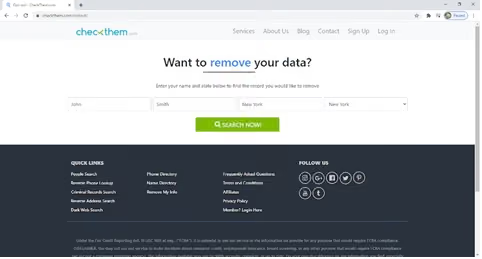
Step 2: Provide the information:
Fill out your name, surname, and your state and city. Hit the search button.
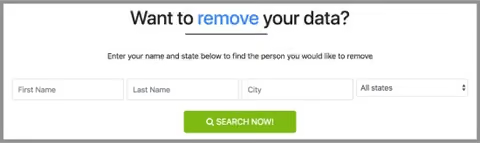
Step 3: Select your profile:
Select your information from the options on the computer and pick it by hitting "Choose."
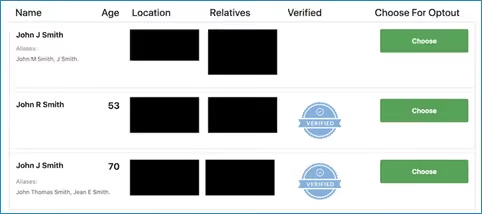
Step 4: Fill Out the Form:
Add an e-mail address, fill out the CAPTCHA and finish the security questions. Then, select "Send Verification Email."
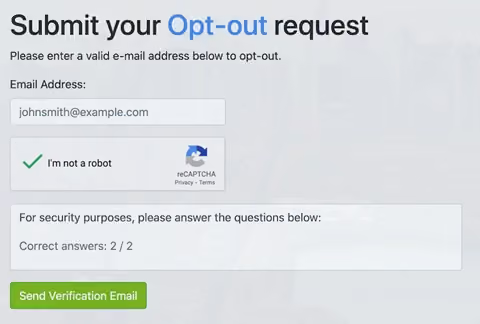
Step 5: In the Verification Email, click on E-Mail:
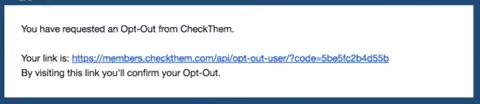
Lastly, go through your mail. CheckThem.com will have sent you an email. Please visit the link in the email to complete your CheckThem opt out. When the procedure is finished, the service will send you an email. It may take a couple of days for the data to just be entirely erased, so keep checking to ensure that all information has been eliminated.

How To Opt-Out, Delete, Or Make Privacy Requests From aPureBase?
Company Overview
aPureBase is a European and worldwide database containing information about stakeholders within the healthcare environment. They collect data related to:
Doctors
Nurses
Pharmacists
Dentists
Health care decision-makers
The aPureBase aims to provide information that can help healthcare professionals in their daily work by having direct access to contact persons, companies, and products. The data is updated regularly in different ways, such as by phone calls, web research, and events.
aPureBase is headquartered in Copenhagen, Denmark. The company's primary product is PureAdvance, a sophisticated software tool that gives users live access to data sets. PureAdvance offers a variety of features, including search, segmentation, list generation (dynamic and static), activity planning and registration, dashboards, compliance management, and more.
aPureBase works with some of the world's leading pharmaceutical companies and many innovative start-ups. They have a deep understanding of the complexities of the global healthcare industry and the needs of our clients. Their team is extremely passionate about making a difference and constantly innovates to find new ways to add value for our clients.
Services Provided
aPureBase provides a range of services to support our client's business objectives, including:
CRM Data – Dynamic Data:
aPureBase offers a complete range of CRM data services that can be tailored to your specific needs. They offer a group of experts who can assist you with all facets of data management, from implementation and operation to strategy and planning.
Mailing Tool:
aPureBase offers a wide range of mailing tools that can be used for direct marketing, market research, or both. These tools include their proprietary PureAdvance software, allowing users live access to data sets.
Mailing Lists – Data On Demand:
If you have a mailing list that you need to keep updated with the latest data, Data on Demand can help. The company can provide the most up-to-date data tailored to your needs.
Call Campaigns:
aPureBase can help you plan and execute call campaigns that are targeted, efficient, and compliant.
Value-Added Services:
aPureBase offers a wide range of value-added services that can be used to support your business objectives.
Targeting - Pure focus:
aPureBase offers a unique targeting service to help you identify and reach your ideal target audience. PureFocus uses PureAdvance software to analyze data sets and identify patterns that can be used to target specific groups of people.
Aggregate Spend – Puresave:
aPureBase offers a complete solution for managing and reporting on aggregate spending.
Type Of Consumer Data Collected
aPureBase collects various data types from multiple sources, including Web research, home calls, Events, Third-party data sources, cookies, etc. This data is then used to populate the aPureBase database, which comprises individual records for each healthcare professional. These records include contact information, demographic data, and data on their specialty, practice, and interests.
In addition, the aPureBase database also includes the company, product, and event records. All these records are linked together so users can easily navigate between them. aPureBase offers various ways to access its data, including its website, its API, and its data visualization tool, PureAdvance.
How Does Apurebase Use Data?
Data is used by pharmaceutical companies and other healthcare organizations
Support various activities, including market research, target audience analysis, event planning, and more.
aPureBase data can be used to create custom reports and dashboards that provide insights into the healthcare industry.
aPureBase is committed to protecting the privacy of its users and their data. All data collected by the company is stored in secure, encrypted databases.
Rights Given By The Law
If you are one of the consumers of their product, you have certain rights included
Access to registered information about themselves
Data rectification
Objection to and restriction of Processing
Objection to automated decision-making and profiling
Data portability
Data erasure
How To Request Deletion Of Private Data?
You may submit a request to delete your data by contacting aPureBase customer support. Please note that if you request the deletion of your data, you will no longer have access to the platform, and all of your data will be permanently deleted. You can contact them at legal@apurebase.com. Do not forget to include your personal information in the email so they can verify you. Or call them at +45 31 33 33 91.
If you have any queries regarding their privacy policy, contact them at their email.
How to Opt-Out, Delete Or Make Privacy Requests From BB Direct?
Company Overview
BB direct is a data-driven marketing company that helps organizations reach their target audiences through direct mail, email, and mobile channels. BB Direct has a team of experienced professionals who understand the ins and outs of direct marketing. They use their knowledge to develop targeted campaigns that deliver results.
The company is committed to helping organizations achieve their marketing goals. Their experts work closely with clients to develop custom solutions that fit their unique needs.
BB direct’s focus on quality data, innovative technologies, and world-class customer service have made them a trusted partner and data provider to some of the most respected brands in the world. BB Direct is headquartered in Cape Coral, Florida.
Services Provided
They proudly offer clients a complete suite of direct marketing solutions that deliver results. Their services include:
List Management:
The company manages lists for some of the largest organizations in the world. They have the right experience to get your message in front of the right people. Their mailing lists have many people from all walks of life.
Data Acquisition:
They help organizations acquire the data they need to reach their target audiences. Their team can help you with list procurement, data cleansing, and more.
Campaign Design and Execution:
BB Direct develops targeted campaigns that get results. Their team will work to devise a custom plan that fits your needs and budget.
Reporting and Analytics:
BB Direct provides detailed reports showing your campaign's performance. They also help you interpret your data and make strategic decisions about your marketing efforts.
BB Direct is your one-stop shop for direct marketing solutions. They have a team of marketing experts dedicated to helping their clients achieve their marketing goals. Whether you're darting to acquire new clients or grow your brand awareness, they can help.
Type Of Consumer Data Collected
BB Direct collects a variety of data from consumers, including:
Contact information: name, address, phone number, email address
Demographic information: age, gender, income, ethnicity
Interests and preferences: what types of products or services are they interested in
Behavioral data: how they have interacted with your brand in the past (online browsing history, purchase history, etc.)
This information was not collected directly; rather, BB direct uses public records to gather your information. They do not have a direct relationship with you.
How Does BB Direct Use Consumer Data?
BB Direct uses consumer data to develop targeted marketing campaigns. This data creates customized lists of consumers most likely interested in your products or services. BB Direct then uses this data to determine the best way to reach these consumers, whether it be through direct mail, email, or mobile channels.
BB Direct has a team of experienced professionals who understand how to use data to create effective marketing campaigns. Their focus on quality data and world-class customer service has made them a trusted partner to some of the most respected brands in the world.
What Are the Benefits of Opting Out Of BB Direct?
There are a few benefits of opting out of BB Direct, including:
You will no longer receive marketing messages from BB Direct.
Your data will no longer be used to create targeted marketing campaigns.
You will no longer be tracked by BB Direct for behavioral analysis.
The Rights Given Under CCPA
The California Consumer Privacy Act (CCPA) gives consumers the right to know what personal data is being collected about them. Consumers also have the right to delete their data and opt out of having their data sold. BB Direct uses this consumer data to market it via mailing lists so that their clients can contact potential customers.
The company follows the CCPA law and allows citizens to opt out of its marketing services. If a customer requests to opt-out, BB Direct will no longer use the customer's data and will stop marketing to them altogether.
How To Request Deletion Of Private Data?
BB Direct offers an opt-out form on their website, which can be used to stop marketing messages and have your data deleted from their system. If you want to opt-out, click here. Fill in the form, and the company will respond in time. This will stop the company from selling your personal information.
After Opting Out
If you have any questions or concerns about BB Direct's use of your personal data or their privacy policy, you can contact them at brianberg@bbdirect.com. You can also contact them using their postal address.
BB Direct
PO Box 151261
Cape Coral, FL 33915
brianberg@bbdirect.com
PH: (866) 501-6273

How to Opt-Out, Delete, or Make Privacy Requests From Acxiom
Acxiom
Company Overview
Headquartered in the state of Arkansas, Acxiom is a company offering data management, data analytics, marketing, and advertising services to businesses for the purpose of managing a customer base and targeting potential customers. They are one of the many companies under the Interpublic Group of Companies (“IPG”), an Agency Holding Company accumulating billions of dollars in revenue each year. (For your interest, you may want to do some research on the IPG; it’s the 4th largest Agency Holding Company in the world in terms of yearly revenue.) Acxiom boasts a list of more than 70 partners on their website, including Adobe, Dish Media, Google Cloud, Meta, Microsoft, Snapchat, Spotify, and Verizon Media. Interested in the remainder of the list? View the list of Acxiom’s big partners on their website using the link below.
Acxiom and Your Consumer Information
It’s always recommended to become familiar with a company’s policy on how they handle consumer information, especially in today’s world where data has become a form of currency. Read or peruse Acxiom’s Privacy Policies applicable to you in the Privacy section of their website to find out how they’re handling your consumer information. The image below shows the main page of their Privacy section as of July 22, 2022.
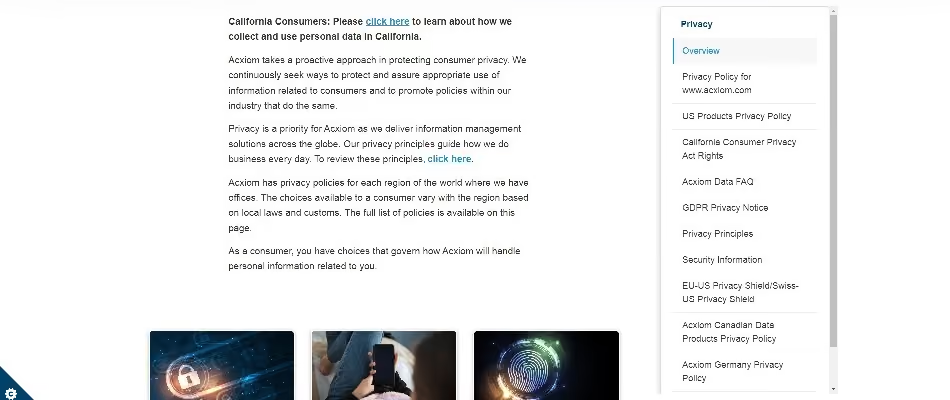
Click on the link below to open the main page of the Privacy section of Acxiom’s website, as in the image above.
Acxiom’s Privacy Section – Main Page
If the link above doesn’t work, click on the “Privacy” link found on the website’s Footer (the bottom section of the website) as shown in the image below.

The pages of their Privacy section titled “Privacy Policy for www.acxiom.com” and “US Products Privacy Policy” admit that the company is involved in the sharing of information among the family of companies under the Interpublic Group of Companies. Both pages can be accessed by clicking on the link in the scroll-down menu located on the right side of the main Privacy page. Acxiom promises that the sharing of such information is in the best interest of:
supporting the relationship between the company and consumers
increasing visitor’s ease in the use of the website
informing consumers of services and product updates, new products, and other related information from the company
Nevertheless, you can’t really trust a company like Acxiom; it’s become common knowledge that data companies often breach their own policies for the sake of profit. If you’re not comfortable with the company’s handling of consumer information, there are means to opt out of their marketing campaigns and request that they delete your consumer information as made mandatory by law.
Acxiom, a Data Broker Company
Acxiom can be classified as a Data Broker Company as it has access to information collected directly from consumers and through third-party companies. With access to so much data on individuals, companies like Acxiom have become the target of corporations looking to increase their already overflowing databases. As a result, there’s a great chance that Acxiom may be selling your consumer information to other companies, and you have a right to be both skeptical and concerned. However, with the law on your side, you can request that Acxiom prevent the sale of your consumer information and even delete that information to give you peace of mind.
Opting Out and Deleting Your Consumer Information
As stated in their Privacy Policy, Acxiom recognizes current US laws granting consumers the right to have their information deleted from the company’s databases and/or opt out of current and future marketing campaigns through which their information can be sold. Therefore, Acxiom has made provisions for anyone desiring to make such requests. No matter if the request is a minuscule link on a webpage or a link lost somewhere in the Privacy Policies, we’ll help you find your way.
Requests to opt out of Acxiom’s marketing campaigns or delete your consumer information are processed online, beginning with an online form. The forms are accessed at the bottom of the “Your Choice for www.acxiom.com” webpage, as shown in the image below.

Click on the link below to access the “Your Choice for www.acxiom.com” webpage containing links to the forms as shown in the image above.
Acxiom’s Request Page to Opt Out, Access or Delete Information
If the link above doesn’t function, a link to the request page can be found under the “Your Choices and How to Contact Us” heading in the “Privacy Policy for www.acxiom.com” page, as shown in the image below.
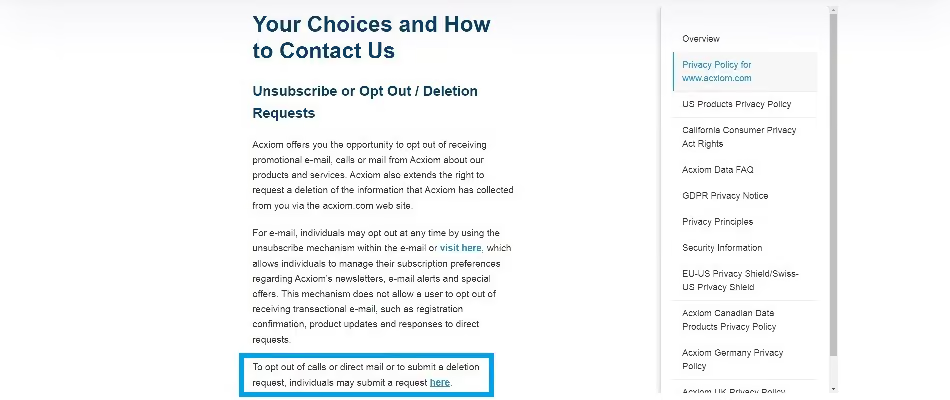
On the request page, click on the “Access/Deletion” link to request deletion of your consumer information or click on the “Opt Out” link to opt out of Acxiom’s marketing campaigns. Both links lead to similar forms in which you need to fill out your personal information and then submit it. An example of the form is shown in the image below.

Acxiom promises that you will receive a response within two weeks in which you will be asked to proceed through an identity verification process before the request can be fulfilled. There is no given timeline as to the length of time it will take for Acxiom to fulfill your request.
Freedom Exercised
If you’ve requested to opt out of Acxiom’s marketing campaigns and/or to have your consumer information deleted from their databases, you’ve made an excellent decision. Feel confident knowing that you’ve become one of many Americans who’ve taken another step to exercise their personal data rights against big businesses and corporations. Be at ease knowing that Acxiom no longer has the right to sell your data to the data-hungry business world.

How to Opt-Out, Delete Or Make Privacy Requests From AnalyticsIQ?
Company Overview
AnalyticsIQ is a data analytics consultancy that helps organizations make better decisions by unlocking the power of their data. They have an entire team of experts with years of experience in data mining, business intelligence, and marketing analytics who are dedicated to helping clients use their data more effectively.
The company's goal is to provide clients with the tools they need to make informed decisions based on accurate information. AnalyticsIQ helps organizations make better decisions by unlocking the power of their data, business intelligence, and marketing analytics.
Type Of Consumer Data Collected
The types of consumer data that AnalyticsIQ collects are:
Demographic data: This includes information such as age, gender, income, education, and location.
Behavioral data includes how consumers interact with brands, what products they purchase, and how often they purchase them.
Psychographic data includes information about consumers' values, beliefs, and attitudes.
AnalyticsIQ also collects data from public sources such as census data, government data, and data from social media platforms.
Type Of Business Data Collected
AnalyticsIQ also collects data from businesses. This includes information such as business size, industry, and geographic location. Additionally, AnalyticsIQ collects data about the type of business (B2B or B2C), the products and services offered, and the business's marketing and advertising strategies.
How Is The Data Used?
The data that AnalyticsIQ collects is used to help businesses make better decisions. This includes understanding consumer behavior, predicting future trends, and identifying new opportunities. Additionally, the data is used to improve marketing and advertising campaigns and to develop new products and services. Furthermore
For promotional purposes on behalf of the AnalyticsIQ clients.
For allowing the personalization of AnalyticsIQ clients' goods and services, such as site optimization, email personalization, and dynamic marketing and advertising optimization.
For building modeled audiences for the goods and services used by AnalyticsIQ clients.
For campaign measurement, analytics, and insight generation.
The Rights Under CCPA And GDPR
The California Consumer Privacy Act (CCPA) and the General Data Protection Regulation (GDPR) both give individuals the right to discover what personal data is being collected about them, the right to have that data erased, and the right to opt-out of its sale. Since these analytic companies use and sell data in order to benefit their clients by targeting marketing strategies. Thus, this law protects the citizens' rights.
AnalyticsIQ is committed to respecting the rights of all individuals under CCPA and GDPR. They will only collect, use, and disclose personal data in accordance with these laws.
Keep reading the following section to exercise your rights under CCPA or GDPR.
AnalyticsIQMarketing Cookie Opt-Out Option:
Suppose you would like to opt-out of having your data used for marketing purposes by AnalyticsIQ. In that case, you can click the "opt-out" button by Visiting the Digital Advertising Alliance's Consumer Choice Tool here to manage your third-party cookie settings, including Google permissions.
To Make A Privacy Request:
To make a privacy request, such as a request to know what personal data is being collected about you, contact them at privacy@analytics-iq.com. Note that you should include your name and telephone number in your request. You will be required to verify your identity before they can process your request. If everything goes well, AnalyticsIQ will respond to your request within 45 days. However, if you want to read their privacy policy, click here.
AnalyticsIQ Company Emails Opt-Out:
You can opt out of the communications directly from AnalyticsIQ by clicking "unsubscribe" on their marketing communications section. An easier way to do this is to email them at info@analytics-iq.com. It is essential to use Opt-Out as the subject line, so the company knows your purpose and saves time filtering emails.
AnalyticsIQ Marketing Database Opt-out And Deletion Request:
Compelling to the laws of the states they work or provide services in, any consumer may choose to opt-out of any future sales of their information from their marketing database. You may make this request by filling out this form.
After Opting Out:
Please note that after you opt out of having your data used for marketing purposes, you may still receive marketing communications from AnalyticsIQ if you have an existing business relationship with them. For example, suppose you are a current customer or have purchased from them in the past. In that case, they may continue to send you marketing communications about similar products and services, but that won't be personalized.

How to Opt-Out, Delete Or Make Privacy Requests From Andrews Wharton?
Company Overview
Andrews Wharton is a data and analytics company that services businesses in various industries. The company was founded in 2001. It is a privately held New York corporation headquartered on Long Island. Andrews Wharton has a team of experienced professionals in data analysis and marketing.
Andrews Wharton's clients include businesses of all sizes, from small businesses to high-revenue companies. The company has dedicated account managers who work with each client to tailor a solution that meets their specific needs. Andrews Wharton is committed to providing the best possible service to its clients and strives to exceed their expectations.
Andrews Wharton offers a wide range of services to help businesses grow and succeed. These services include:
Data Collection:
Andrews Wharton collects data from various sources, including online databases, government agencies, and private companies. This data is sorted and organized into a format that is easy for businesses to use.
Data Analysis:
Andrews Wharton's analysts will examine data and provide insights businesses can use to make better decisions. This includes identifying trends, understanding customer behavior, and predicting future needs.
Marketing Consulting:
Andrews Wharton provides consulting services to help businesses develop and implement effective marketing campaigns. This includes assistance with planning, budgeting, target audience selection, and more.
Type Of Consumer Data Collected
Andrews Wharton collects data from a variety of sources. This data is sorted and organized into a format that is easy for businesses to use. Personal information is not collected unless you contact them via email or chat. Some of the types of consumer data collected by Andrews Wharton include:
Demographic information such as age, gender, income, education level, etc.
Psychographic information such as interests, values, lifestyle, etc.
But when you visit their website, they collect specific data, including internet protocol (IP) address, the type of browser or device operating system you use, and similar data.
How Does Andrews Wharton Use Consumer Data?
Andrews Wharton's products and services are based on a deep understanding of consumer behavior. We use this understanding to develop innovative products and services that help our clients to grow their businesses. The company can use your information for:
Behavioral Advertising
Third-party advertisers may collect information about your visits to the website and your interactions with their products and services. The Advertisers may use this information to serve ads that they believe will be most interesting to you.
Apart from this, the company uses your data;
To run and enhance the website.
To answer your direct questions, we could utilize your personal information.
To add you to our mailing lists, we sometimes send you emails, and notify you of service and product updates.
Give our vendors and service providers access to your personal information (such as our payment processors, email service providers, host providers, and personnel management service providers).
Provide it to law enforcement authorities to investigate any harassment charges.
The Rights Given Under CCPA
The California Consumer Privacy Act (CCPA) gives consumers certain rights concerning their personal data. These include the right to know what personal data is being collected, the right to see how that data will be used, the right to delete that data, and the right to opt-out of the sale of that data.
How To Request Deletion Of Private Data?
Disclosure Of Data:
You can request the company to disclose the data they have on you. You have to email them at privacy@andrewswharton.com.
Deletion Of Data or Do Not Sell Request:
You can also request to delete your personal information or file a request not to sell it that has been collected about you. Click here to submit a proposal and fill out the form with your personal information.
File A Complaint: If you want to launch a complaint against the company's privacy policy, you can email them at privacy@andrewswharton.com.
The company will respond to your request within 45 days. To protect your personal information, it may take steps to verify your identity before fulfilling your request. This may include asking you for information that allows them to confirm your identity, such as your name, address, or date of birth.
You can also call them at 1-866-628-1150 and enter Service Code 809. Please include your full name, email address, phone number, and state of residence, along with the rights you wish to exercise so that the company can process your request efficiently.
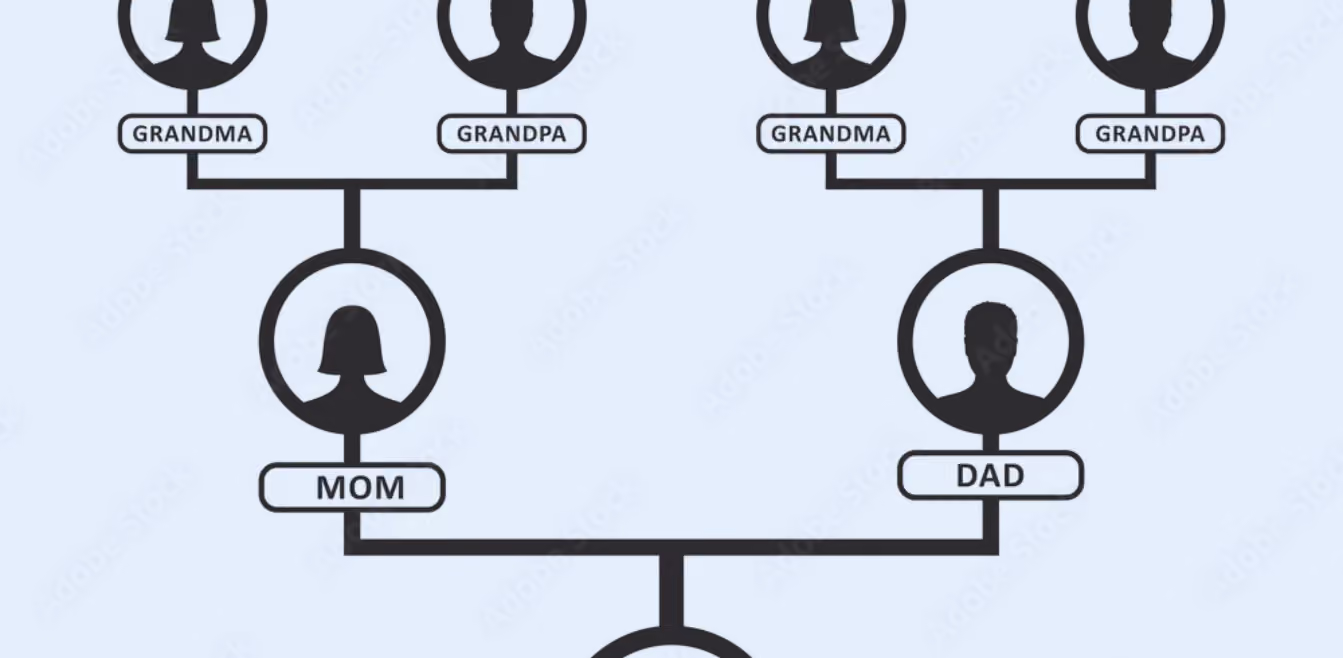
How to Opt-Out, Delete Or Make Privacy Requests From Ancestry?
Company Overview
Most people know where they come from, but for some, that knowledge is more than just an exciting family history. It can be a matter of personal identity. That's why many people are turning to ancestry websites like Ancestry.com to help them learn more about their families.
The company has a massive database of records that can help you find information about your ancestors. In addition, Ancestry offers access to billions of additional records through its partnerships with significant genealogy providers.
Ancestry provides various services to help people learn more about their families. These services include access to an extensive database of historical records, tools to help track down family members, and support for building family trees. In addition, the website offers a variety of resources to help people research their families, including articles, tips, and advice from experts.
Not everything you find on an ancestry website will be accurate. That's why taking everything you read with a grain of salt is important.
Type Of Consumer Data Collected
Ancestry collects various data from its users, including information about their families, personal history, and genetic makeup. The company also gathers data from public records, such as birth certificates and death records. In addition, Ancestry.com partners with other companies to provide access to additional records, such as census data.
User Data:
Ancestry users provide information about themselves and their families when they sign up for the service. This information includes names, birth dates, residence places, and other personal details. In addition, users may also upload photographs and documents, such as birth certificates and marriage licenses.
Public Records:
In addition to user-provided data, Ancestry also collects data from public records. This data includes birth certificates, death records, and census data.
Genetic Information:
Ancestry also offers a DNA testing service that allows users to learn more about their genetic makeup. Users who take the DNA test receive a report containing information about their ethnicity, ancestral origins, and risk of certain diseases. Ancestry does not sell user-generated DNA data.
DNA Kit Activation Information
When you activate a DNA test kit, Ancestry collects:
Your DNA test kit code;
Your assigned sex at birth; and,
Your year of birth.
How Is The Data Used?
The data collected by Ancestry is used for the following purposes.
To deliver, customize, enhance, maintain, and grow services. Authenticating the use of the Services and enhancing the security of Ancestry information.
For processing payments for memberships, test kits, and services
To construct new services and enhance current ones.
To assist you in building your family tree based on information in Ancestry's databases and offer you insights into it.
For the distribution of surveys and questionnaires for the Services' usage, as well as supporting efforts for product development and research;
Performing research in the fields of science, statistics, and history
To send you marketing messages about the services.
How To Request Deletion Of Private Data?
California residents have the right to seek information about the Personal Information Ancestry collects, uses, discloses, or sells under the CCPA. This includes the right to ask for the categories of personal information they have, the sources from which they have obtained it, the reason(s) for collecting it on behalf of a legitimate business interest, and the categories of third parties with whom they can share those categories of personal information.
Other citizens can also benefit from this, but it is subject to applicable laws and policies.
If you want to download a copy of your family tree, you can click here.
If you want to request a copy of the personal data collected by the company, click here.
If you want to download a copy of your DNA data, click here.
To submit a request for the deletion of data from the company database, you first need to delete your account. To do so, click here.
Some of the data is individually collected by partner companies; if you want to request data deletion from one of the partner companies, click here.
You can do all of the above procedures by sending them relevant emails at ccpasupport@ancestry.com. The company will verify your identity and process your request under the applicable laws. Also, you can contact them at this email if you have any queries related to the company's privacy policy.

How to Opt-Out, Delete, or Make Privacy Requests from Censia
Company Overview
Censia is a company with the goal of providing employers with potentially the best talent for a job based on its requirements. With its headquarters in California and a branch on the other side of the country in Florida, Censia is very similar to a recruitment agency assisting employers in finding new employees. Using the power of Artificial Intelligence and a pool of data form many different sources, they select an individual best suited for any employment. The company works along with six partners within the same business sphere, namely Greenhouse, iCIMs, Jobvite, Phenom, Recruiter, and SAP SuccessFactors. You can view the list of Censia’s partners on their website using the link below.
Censia and Your Consumer Information
Are you curious to know how a company like Censia handles consumer information? Well…..you should be. Ever since data became the new currency in today's business world, there’s no excuse to not learn about a company's policy on data handling. So, take some time to peruse Censia's Privacy Policy which can be accessed on their website. Click on the link below to open the company’s Privacy Policy which was effective since February 24, 2020.
If the link above doesn’t work, click on the “Privacy Policy” link found on the website’s Footer (the bottom section of the website) as shown in the image below.

In the section titled “Types of Information We Collect” in Censia’s Privacy Policy, a well-formulated table details the many different kinds of data collected by the company and their specified purpose for the collection of such data. In addition, the sections titled “Sharing Of Information” and “Your Choices” declares that the company shares and sells information to affiliates and third parties.
Are you still comfortable with the way Censia is handling your consumer information? Thanks to new US laws, you can request to opt out of their marketing campaigns or have your consumer information deleted from their databases. After all, we can't wholeheartedly trust these data companies since they're always willing to sell consumer information to the highest bidder.
Censia, a Data Broker Company
Censia is a data broker company that has access to information collected either directly from consumers or from other companies. With access to so much data on individuals, companies like Censia are targeted by corporations wishing to expand their large databases to increase marketing profits. As a result, you have a right to be both skeptical and concerned, as Censia may be selling your consumer information to other companies. Nevertheless, with new US privacy laws, you can request that Censia prevent the sale of your consumer information and even delete that information from their databases. Talk about peace of mind.
Opting Out and Deleting Your Consumer Information
Opting out of Censia’s marketing campaigns and requesting the deletion of your consumer information from their databases is made possible thanks to the provision of current US laws. Whether it’s a single paragraph hidden deep within the Privacy Policies or an almost invisible link at the bottom of the webpage, we’ll assist you in making that important request to protect your consumer information.
Requests to opt out of Censia’s marketing campaigns or delete your consumer information are done through communication with the company using one of the following means below. Please note that no matter the means selected, you will be asked to proceed through an identity verification process before your request can be fulfilled. There is no given timeline as to the length of time it will take for Censia to respond to your initial communication or to successfully fulfill your request.
Online Form
Fill out and submit an Online Form in the “Exercise Your CCPA Rights” page as shown in the image below as of July 2022.
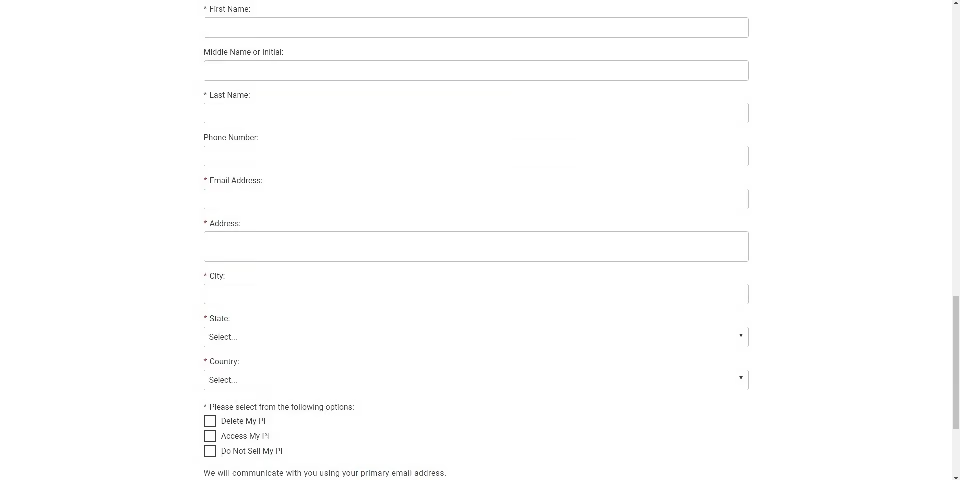
Click on the link below to access the “Exercise Your CCPA Rights” page, as shown in the image above.
Censia's Exercise Your CCPA Rights Online Form
Don’t forget to select the Access Delete My PI or the Do Not Sell My PI checkboxes or both when filling out the form. You will be contacted by Censia using the email provided to confirm and proceed with the request.
Online Ticket
Fill out and submit an Online Ticket in the Support section of the website as shown in the image below as of July 2022.

Click on the link below to access the New Requests Online Ticket Page as shown in the image above.
Censia's Support Page for New Requests
Click on the link below to access the New Requests Online Ticket Page, as shown in the image above.
Censia's Support Page for New Requests
This Online Ticket is for all forms of requests which can be made through Censia via their website; therefore, you need to carefully select the correct courses of action while filling out the ticket. Let us help you through the first phase.
On the main new request page in the Please choose your issue below field, select “Customer Feature Request Ticket Form”. On the following page, fill out the required fields while selecting the correct Category.
To delete your consumer information, select “Formal Request to be Deleted” from the Category field.
We realize that there is no opt-out option in the Category field, so you may have to select “Other (Explain in Notes)” and then explain yourself in the Long Description field below.
Telephone
Give Censia a call at 1 (888) 510-2253 and request to opt out of their marketing database or request that they delete your consumer information.
Freedom Exercised
When you've decided to opt out of Censia's marketing campaigns and/or requested to have your consumer information deleted from their databases, you've exercised your personal rights against big businesses and corporations. You're one of the many Americans who feel confident that Censia can no longer sell your consumer information to the power-hungry businesses. Doesn’t that feel great?

How to Opt-Out, Delete, or Make Privacy Requests from 123verified.com
How to Opt-Out, Delete, or Remove My Privacy from 123verified.com
In the list of data brokers, 123verified.com is one of the data brokers owned by Skenzo Ltd. which is involved in selling your personal information online. When you visit their website, they have mentioned multiple tabs to help you in finding the kind of information, you are looking for. For instance, they have made different categories for search information such as Individual Background Checks, Free Background Checks, Criminal Background Checks, Background Checks, Looking for Free, Free People Search, and Search People Online.
So, if you are looking for such information online, you can visit 123verified.com. However, if you are the one who is concerned a lot about his/her privacy and don’t want to show your personal information online at 123verified.com, then you will have to contact them to opt-out, delete, or remove your privacy and information from their database.
The process to opt-out from 123verified.com
We are here to guide you in opting out and removing yourself from the database of 123verified.com.
Step 1:
Visit the Privacy Page of 123verified.com at http://123verified.com/sk-privacy.php
On this page, you will find a lot of information like how they use your personal information, what they do to protect your information, how this information is accessed by third parties, how they manage cookies policy, etc. This is the first step to getting an idea, of what you can do to get yourself removed from their database.
Step 2:
Visit the page at http://123verified.com/dispute.doc, and you will get a form that you can print.
Step 3:
After printing out this form, fill it in accordingly by sharing your listing on their site so that you can ask them to remove your data and information from 123verified.com. You can also include any other relevant documents along with your application.
Step 4:
Once the application form is filled out properly, you will have two options to send it: one option is to send it by mail, and the other is by fax. Here are the details for both:
-Fax at 1-800-942-4888
-Mail at 1st Check, Inc.
Disclosure Department
PO Box 1002,
Buffalo, NY 14210
What if you are a resident of California?
It is important to mention here that if you are a resident of California, then you have extra privileges to get yourself removed from such data brokers’ sites. There is a California Civil Code (CCPA) that allows residents of California to have so many additional rights. The good thing is that 123verified.com has included a detailed section in this regard on their Privacy Policy page.
This section of the privacy policy helps you to know about your additional rights as a resident of the state of California. To exercise your rights as a California resident, they have clearly mentioned on their privacy policy page by describing that “To exercise your rights under the CCPA, please submit a request by either (1) calling us at +1-(415)-358-0868; or (2) emailing us at skenzo”
Further, you can visit this link to submit your request: https://skenzo.com/ccpa.php
What if you are from the EU?
It is important to note down by that EU citizens that they also enjoy certain additional rights regarding their privacy and personal information. Again, 123verified.com has made sure to include this part in their privacy policy so that EU users have detailed information in this regard.
So, if you are an EU citizen, and have an objection about your privacy at 123verified.com, you can get in touch with them by sending an email at skenzo. After reviewing your application and request, their team will get back to you with a valid response complying with the rules and regulations.

How to Opt Out, Delete, or Make Privacy Requests from Accudata Integrated Marketing
AccuData Company Overview
AccuData Integrated Marketing (“AccuData'') is a Florida based company providing data management, data analytics and digital marketing services to businesses with the aim of assisting them to market their products and services to existing and potential customers.
AccuData and Your Consumer Information
Data is a new form of currency in today’s world; this is the reason why you need to understand how data management companies like AccuData handle your consumer information. AccuData’s Privacy Policy is presented in the form of a well-organized PDF, which can be accessed or downloaded from the company’s website. Read it carefully at your own pace and learn how the company intends to handle everyone’s consumer information. Click on the link below to open AccuData’s Privacy Policy, which was last amended on January 1, 2020:
AccuData Integrated Marketing Privacy Policy
If the link above doesn’t work, click on the “Privacy Policy” link found on the website’s Footer (the bottom section of the webpage) as shown in the image below.

According to Section 3 of the Privacy Policy titled: “How We Share Information with Third Parties”, and Section 6 titled: “How AccuData Shares the Information We Collect Through Our Websites”, AccuData declares that they may share (and potentially sell) your consumer information for the purpose of:
managing user accounts
communicating and providing services
providing offers and advertisements
data analysis and market research
gathering demographic information on visitors
It’s become commonplace for data companies, like AccuData, to breach their own policies by selling consumer information to businesses willing to foot the bill. If you’re not comfortable with AccuData’s use of your consumer information, they have made it easy for you to opt out of their marketing database or have your information deleted at your request, as it was made mandatory by law.
AccuData, a Data Broker Company
AccuData can be classified as a Data Broker Company as it has access to information collected directly from consumers and through third-party companies. With access to so much data on individuals, companies like AccuData have become the target of corporations looking to increase their already overflowing databases. As a result, there’s a great chance that AccuData may be selling your consumer information to other companies, and you have a right to be both skeptical and concerned. However, with the law on your side, you can request that AccuData prevent the sale of your consumer information and even delete that information to give you peace of mind.
Opting Out and Deleting Your Consumer Information
AccuData provides a channel for anyone who has previously provided information to the company to request to be opted out of their marketing database whenever he/she desires. AccuData promises to process your request within 30 days or less, depending on the laws of your current state. You can request to opt out via communication with them using one of the following means:
Online WebformAccuData provides various means for anyone wishing to opt out of the company’s marketing database or have their consumer information deleted. This is all thanks to current US laws, which provide consumers with the right to exercise control over the information that companies have collected. AccuData promises to process your request within 30 days or less, depending on the laws of your current state. You can make your request known using one of the following means below.
Online Webform
Fill out and submit the Opt Out Webform as shown in the image below. You will be asked to proceed through an identity verification process before your request can be fulfilled.

Click on the link below to access the Opt Out Webform as shown in the image above.
AccuData Integrated Marketing Opt Out Webform
If the link above doesn’t work, a link to the webform can be found on AccuData’s website. At the website’s Footer (the bottom section of the webpage), click on the “Do Not Sell My Personal Information” link as shown in the image below.

Telephone: Give AccuData a call at 1 (800) 371-7080 and request to opt out of their marketing database or request that they delete your consumer information.
Email: Send AccuData an email requesting to opt out of their marketing database or request for the deletion of your consumer information. The email address for such a request is privacy.compliance@accudata.com.
Mail: Type a letter requesting to opt out of their marketing database or to have your consumer information deleted, then mail it to the following address:
AccuData Integrated Marketing, Inc.
Attn: Privacy Officer
12901 McGregor Blvd., Suite 1A
Fort Myers, FL 33919
Freedom Exercised
Opting out of AccuData’s marketing campaigns and/or having your consumer information deleted from the company’s databases is a superb decision. How do you feel knowing that AccuData can no longer sell your data to the power-hungry businesses feeding on consumer data for profits? You’ll feel great, of course, and even better knowing that you are one of many Americans exercising their privacy data rights against big businesses and corporations.

How to Opt-Out, Delete, or Make Privacy Requests From Alescodata
Company Overview
Alescodata is a data management company specializing in data visualization and analytics. Founded in 2001, they are headquartered in the United States Of America with offices across the globe. They have a team of data experts who help organizations make better decisions by turning data into insights. Alescodata works with companies of all sizes, from startups to Fortune 500s, across various industries, including finance, healthcare, and technology.
Alescodata has a wide range of products and services to help organizations with their data needs. Their products include data visualization, analytics, management, and security. They also offer consulting services to help companies with their data strategy, implementation, and training.
Alescodata is committed to helping organizations use data to improve their business. Their team of experts is passionate about helping companies succeed, and they constantly innovate to provide their clients with the best products and services.
Type Of Consumer Data Collected
Like other marketing companies, Alescodata collects some of the consumer data through various sources to help build insights. These insights are then used to benefit their clients and help boost their sales and reach via targeted marketing strategies based on consumer interest. The types of consumer data that Alescodata collects can be broadly classified into the following categories:
Personal Data:
This is data that can be used to identify an individual. It includes information such as name, address, email, phone number, etc.
Demographic Data:
This is data that describes a population. It includes age, gender, income, education, etc.
Behavioral Data:
This is data that describes how people behave. It includes information such as what they buy, when they buy it, how often they buy it, etc.
How Does Alescodata Use Consumer Data?
Alescodata uses consumer data to help their clients understand their consumers better and make more informed decisions about their marketing strategies. They use data visualization and data analytics to turn data into insights that can be used to improve marketing campaigns, target specific audiences, and track the performance of marketing initiatives.
Additionally, they use data management and security technologies to protect their clients' data and keep it safe from unauthorized access. They offer consulting services to help companies with their data strategy, implementation, and training.
What Are the Benefits of Opting Out Of Alescodata?
There are several benefits of opting out of Alescodata.
First, it will help you protect your privacy.
Second, it will help you avoid using your data for marketing purposes.
Third, it will help you stop receiving targeted marketing messages from Alescodata.
Finally, it will help you reduce the amount of data that Alescodata has about you.
The Rights Given Under CCPA
If you are a California resident, the California Consumer Privacy Act (CCPA) gives you the right to opt out of selling your personal information. Under CCPA
You have the right to see what data Adcolony stored
You have the right to submit an official request to delete the data stored about you
The right to prevent the company from selling your data to any third party or partner company.
You can even sue the company for illegal data usage.
It is to be noted that Alescodata only stores users' information in the United States and Canada; hence the GDPR does not apply to them.
How To Request Deletion Of Private Data?
Disclosure Of Data:
You can request the company to disclose the data they have on you. You just have to click here and fill out the necessary information.
Deletion Of Data:
You can also request to have the personal information that has been collected about you deleted. Click here to submit a deletion request and fill out the form with your personal information.
File A Complaint:
If you want to launch a complaint against the company, you can email them at info@alescodata.com.
A CCPA (California Consumer Privacy Act) compliance specialist is available at (877) 652-5002 if you'd like to learn more about opting out of having your data removed from our database.
After Opting Out: If you still need any assistance with the privacy policy, you can contact them at privacy@alescodata.com. Their customer service representative will guide you.

How to Opt-Out, Delete, or Make Privacy Requests from 411.info
411.info is an online platform that works as a data broker to sell individuals' personal information through People Search and Reverse Phone Lookup. It is a site that is also known for providing data regarding businesses such as Coffee Shops, Restaurants, Banks, Service Stations, Pharmacies, taxis, Hotels, Shopping, Hospitals, Grocery Stores, Beauty Saloon, etc. The other important information to keep in mind is that 411.info is not only useful for the search in the United States, but it is also beneficial to search for people and businesses in Canada.
411.info has mentioned on its site that they don't charge anything for its data-rich online services like People & Business Research. They are also a unique platform that helps people look up information on real estate in the U.S. and Canada. The company claims that they are providing online data services to connect family & friends, helping buyers & sellers to reach out, as well as, helping people to find out businesses and real estate properties in their areas. They have a slogan of “Let Us Put You in Touch.” Regardless of their privacy promise and security measures, if you feel that you don't want to have a presence in their database as an individual or business, then you can ask them to remove you from their platform.
The process to Opt Out, Get Removed, or Delete Yourself from 411.info
Step 1:
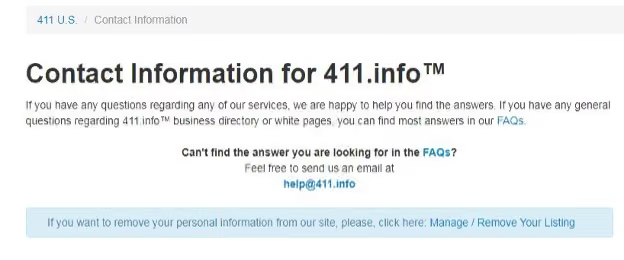
For removal requests at 411.info, you need to click this page https://411.info/contact
Step 2:
On this page, you will see a written part, that states “If you want to remove your personal information from our site, please, click here: Manage / Remove Your Listing”. Then click this part as per instructions, and you will be moved to the next page.
Step 3:
When you reach the page, you can see a detailed statement by the company, which states that “411.info™ provides a free local search and directory service with coverage in the USA. Phone numbers are sourced from public records which are typically published by telecommunications companies in their business directories and white pages. If there is a listing on 411.info™ that you wish to be removed, you can choose an option on this page to remove it, or hide it from public view.” So, if you are an authorized person to ask for the removal of information, you can go ahead by finding your listing after entering the phone number or first and last name.
Step 4:
On this page, you will see the personal information of different people. You can check whether your name is there in the list, and then you can click the part in blue, “Click to Remove”
Once you will click the remove button, 411.info will continue with the process of removing your details and information from their database.
Updating the Information
The above process is explained for you to remove and delete your data from the 411.info. Moreover, if you see any kind of wrong details regarding your business on this site, you can also ask them to update the information and make corrections if there is any wrong information. For this purpose, you can click “Add / Update a Business Listing” at the bottom of the page in the More Section. You would put the name of your business, click on the "Check" button, and the next page would help you to update the information accordingly.
When the businesses list is opened, you can find out your name, and click the blue button which says “Click to Update/Remove”. This is how you can update your business information, as well as, you can remove it if you want to.

How to Safeguard Your Information from Data Brokers
Information is easier than ever to obtain in the digital age, but our data is more vulnerable now than before. Data brokers collect, take, and share personal information daily without your permission.
Marketers, advertisers, and even cybercriminals use this information to target you in various ways, from your home location to your purchasing history. If you're serious about your privacy, it's crucial to protect your personal information from these data brokers.
Data brokers gather massive amounts of data from public documents, the web, and even social media profiles. They then sell this information to businesses, government organizations, or anyone willing to pay. Unfortunately, this puts you at risk of identity theft, fraud, or other harmful actions.
The bad news is that these data brokers can access your credit card information, your location, or even more sensitive details that might seem unimportant until something goes wrong. In this blog, we’ll discuss the threats, offer practical solutions to protect yourself, and introduce PrivacyHawk along with other tools to make it easier. Protect your info and get PrivacyHawk to take control of your privacy!
The Risks of Data Brokers
Data brokers operate quietly behind the scenes, collecting and selling your personal information to third parties. While some data is collected legally through public records, much of it comes from scraping online sources without your knowledge.
This can include:
Your address, phone number, and email.
Details about your job, income, and financial status.
Shopping habits and preferences.
Social Security numbers and other sensitive information.
The risk is clear: when your personal data is widely available, it can easily fall into the wrong hands. Hackers can exploit this information for identity theft, phishing attacks, and even fraud. Worse still, you may not even be aware that your data has been exposed until it’s too late.
A recent breach involving National Public Data, a major data broker, exposed 2.9 billion records, including Social Security numbers, names, and addresses. Incidents like this highlight just how vulnerable our personal information can be in the hands of data brokers.
How to Protect Your Data
Fortunately, there are several steps you can take to protect your personal information from being collected and sold by data brokers. These strategies range from improving your privacy settings to using specialized tools to help monitor and delete your data.
1. Adjust Your Privacy Settings
One of the simplest ways to limit the information that data brokers can access is to adjust your privacy settings on social media platforms, apps, and websites. By limiting who can see your information, you reduce the chances of it being scraped by data brokers.
Limit who can view your posts and profile.
Avoid sharing sensitive details like your full address or phone number online.
Turn off location tracking on apps and websites whenever possible.
2. Opt-Out of Data Collection
Many data brokers allow you to opt out of having your information sold or shared. While the process can be time-consuming, it’s an effective way to minimize the exposure of your personal data.
Check each data broker’s website for opt-out options.
Submit requests to remove your data from people search sites.
Follow up regularly to ensure your information has been deleted.
This process can be daunting, especially when there are hundreds of data brokers operating online. However, opting out is an essential step toward safeguarding your personal information.
3. Use Privacy Protection Tools Like PrivacyHawk
For those who don’t have the time or expertise to manually opt out of data brokers, tools like PrivacyHawk offer a much easier solution. PrivacyHawk is a powerful privacy app that scans for where your personal data is being exposed online and helps you remove it from data brokers and people search sites.
PrivacyHawk offers several features to help protect your personal information. It scans the web, including data brokers and people search sites, to find where your data is exposed and helps you unsubscribe or prevent the sale of your information. The app also provides a unique Privacy Score that allows you to track how much of your data is at risk and take action to improve your privacy.
Additionally, you’ll receive real-time breach alerts if your data is found on the dark web or involved in a data breach. In case of identity theft, PrivacyHawk provides up to $1 million in identity theft insurance to cover recovery costs. It simplifies the process of removing your data from data brokers, ensuring your personal information remains secure.
Some key benefits of using PrivacyHawk include:
With just a tap, you can opt-out and remove your personal information from data brokers.
By cutting off data brokers’ access to your personal details, PrivacyHawk helps reduce the number of unwanted calls, emails, and texts you receive.
From data breach alerts to identity restoration services, PrivacyHawk offers comprehensive protection against identity theft.
Don’t wait until it’s too late - start using PrivacyHawk today to protect your information!
What You Can Do to Stay Safe
Staying vigilant and proactive is key to protecting your personal information from data brokers. In addition to using tools like PrivacyHawk, here are a few more steps you can take:
Be Cautious with What You Share:
Think twice before sharing sensitive details online. Even something as simple as your birthday can be valuable to data brokers.
Monitor Your Privacy Settings:
Regularly check and update the privacy settings on your social media accounts, apps, and devices.
Stay Informed About Data Breaches:
If a company you do business with experiences a data breach, take immediate action to protect your information by changing passwords and monitoring your accounts.
Use Strong Passwords:
Ensure your passwords are strong and unique for each account. This makes it harder for hackers to access your information if one of your accounts is compromised.
FAQs
1. What exactly do data brokers do with my information?
Data brokers collect, buy, and sell your personal information to companies that use it for marketing, advertising, or analysis. In some cases, this data can be used by fraudsters for malicious purposes, such as identity theft.
2. Can PrivacyHawk delete my information from all data brokers?
Yes, PrivacyHawk helps remove your personal data from thousands of data brokers and people search sites, reducing the risk of your information being sold or exposed.
3. How do I know if my data has been exposed to a breach?
PrivacyHawk offers real-time breach alerts that notify you if your personal information is found in a data breach. These alerts allow you to take quick action to protect your identity.
Conclusion
Safeguarding your personal information from data brokers is crucial in today’s digital age. With the rise in data breaches and identity theft, taking steps to protect your data has never been more important. Adjusting your privacy settings, opting out of data collection, and using tools like PrivacyHawk can go a long way in keeping your information secure.
Data brokers may be collecting your personal details without your knowledge, but with the right tools and strategies, you can take back control of your privacy. Protect yourself, safeguard your information, and stay one step ahead of the data brokers.

Keller Williams Realty’s Privacy Policies And How To Delete Your Data Or Opt Out
Introduction
Keller Williams Realty, Inc. outlines its privacy practices in its Privacy Policy, detailing how personal information is collected, used, and disclosed through various platforms and interactions, including their websites, mobile applications, online forms, emails, and offline interactions.
The policy covers the types of personal information collected, such as identifiers, sensitive information, and commercial information, among others. The collected information is utilized for several purposes, including service provision, marketing, personalization, and participation in promotions. The policy also mentions the aggregation and anonymization of personal information for legitimate use.
Keller Williams Realty’s Privacy Practices
Keller Williams Realty, Inc., along with its affiliates, has outlined its privacy practices in a Privacy Policy, last updated on May 9, 2023. Here’s a detailed breakdown of their privacy practices:
Information Collection:
Keller Williams collects, uses, and discloses information through several channels including:
KW Websites and Keller Williams-branded web applications.
Mobile applications like Keller Williams Command and Consumer mobile applications.
Online contact or survey forms are sent via email or accessed from their websites or apps.
HTML-formatted email messages linking to their Privacy Policy.
Offline interactions with individuals.
Types of Information Collected:
Identifiers: Real name, postal address, email address, phone number, IP address, or other similar identifiers.
Protected Classification Characteristics: Social Security number, veteran or military status, gender identity, ethnicity, and primary language.
Commercial Information: Real estate buying/selling interests.
Professional or Employment-related Information: Current occupation, education level, and realtor license number.
Geolocation Data: Derived from an IP address or mobile device.
Device Information: Contacts, photos, and location from the device, if shared.
Account Information: Account log-in information for third-party services like Facebook and Google if linked to KW websites or apps.
Purpose of Information Collection and Usage:
To provide access to their website and communicate in response to their website usage.
To provide and improve services, develop new products or services.
For marketing purposes, social sharing, and facilitating user participation in promotions.
To provide personalized services based on user preferences and analyze user preferences for business reporting.
Aggregating and/or anonymizing personal information for legitimate use, like improving the operation and management of their services.
Users’ Control Over Their Data
Users can contact Keller Williams if they wish to stop the processing of their data. Additionally, Keller Williams was involved in a settlement concerning TCPA claims, where it was indicated that some of its franchisee real estate agents allegedly engaged in unauthorized communications, highlighting an instance where privacy concerns were raised.
It's important to note that Keller Williams operates as a franchisor, and the privacy practices of its independently owned franchisees and their real estate agents might differ from those of Keller Williams Realty, Inc. Hence, it's advised to consult with the individual market centers and real estate agents to understand their specific privacy practices.
How To Contact Keller Williams Realty's Privacy Department?
To get in touch with the privacy department of Keller Williams Realty, you have the following options:
Email: You can send an email to privacy@kw.com or DSAR-KW@kw.com. When emailing, ensure to clearly state in the subject line or the body of the email that your request concerns privacy matters. It's also advisable to include your name, street address, city, state, zip code, and an email address or phone number where they may contact you in case they need further information regarding your request.
Phone: You can also reach out by phone at (877) 507-0072. Similar to the email, make sure to clearly state that your request concerns privacy matters.
Keller Williams Realty's Headquarters: You could possibly contact the privacy department through the headquarters: Keller Williams Realty International 1221 South Mopac Expy, Suite 400 Austin, TX 78746 Phone: 512-327-3070.
Postal Mail (Legal Department): Although not specifically addressed to the privacy department, you could potentially send mail to Keller Williams Realty, Inc.'s Legal Department at the following address: Keller Williams Realty, Inc. Attn: Legal Department 1221 South MoPac Expressway, Suite 400 Austin, TX 78746.
These channels are your best bet to reach the privacy department of Keller Williams Realty and address any concerns or inquiries you might have regarding privacy.
How To Delete Your Data From Keller Williams Realty?
According to their privacy policy, you can email Keller Williams Realty at privacy@kw.com to make delete requests. PrivacyHawk can also help identify companies that have your personal data and makes it easy to mass delete yourself to reduce your digital footprint and reduce your risk of being targeted by scams, fraud, and identity theft. You can try it for free on the App Store today.

Koch Industries’s Privacy Policies And How To Delete Your Data Or Opt Out
Introduction
Koch Industries' Privacy Policy reflects their commitment to respecting individuals' privacy concerns regarding their information. The policy applies globally to Koch Industries, Inc., its affiliate companies, and its subsidiaries, encompassing data collected online, offline, mobile applications, or other sources.
It aims to explain their practices regarding the personal information they collect, and while it provides a broad description of their global practices, it acknowledges that local laws may necessitate more limited practices in certain jurisdictions.
Koch Industries’s Privacy Practices
Koch Industries has outlined its privacy practices in its Privacy Policy. Here's a detailed breakdown:
Information Collection and Usage:
Personal Information:
They may collect personal information through their websites or other means like email, fax, mail, or phone. The types of personal information collected could include names, email addresses, phone numbers, and financial information.
Automated Information Collection:
Through automated means like cookies, web beacons, and IP addresses, certain information is collected to tailor their websites to visitors.
Specific Uses of Information:
Communication:
Information may be used to send business alerts, newsletters, or other communications and to respond to inquiries.
Scholarships, Grants, and Awards:
Information provided when applying for scholarships, grants, or awards is used in the selection process.
Employment Applications:
Information from job seekers is used to evaluate qualifications for employment.
Business Purposes:
Personal information may be used for business-related purposes like administering websites, data analytics, and legal compliance.
Information Technology Security:
Personal information may be collected to defend against security threats.
Information Sharing:
Koch Industries may share personal information with affiliates and service providers performing services on their behalf. They do not sell or otherwise disclose personal information, except as described in their policy, which may include disclosures required by law or legal process to law enforcement or to protect the rights, property, or safety of Koch Industries or others.
Other Policies:
Koch Industries' privacy practices also extend globally to its affiliate companies, covering a broad range of entities under the Koch umbrella.
Contact and Feedback:
Individuals can contact Koch Industries with questions, requests, or comments and may be asked for personal information to facilitate communication.
Vendors and Contractors:
Vendors or contractors may be asked to provide personal information to establish and administer accounts, process payments, and for compliance with internal and legal requirements.
These practices reflect Koch Industries' commitment to respecting individuals' concerns about privacy and are designed to govern the collection, use, and disclosure of personal information both online and offline.
How To Contact Koch Industries's Privacy Department?
To contact the privacy department of Koch Industries, you have several options:
Webform:
You can use the Privacy Intake Webform provided on their Privacy Policy page to submit your inquiry or request regarding privacy issues.
Contact via Phone:
You can contact Koch Industries' Customer Service from Monday through Friday, 8:00 AM – 5:00 PM central time, at the following numbers:
Main: 763-475-6500
Toll-Free: 800-428-8282.
Mail:
You can also contact them by mail. Depending on the specific entity within Koch Industries you wish to contact, the addresses are as follows:
Koch Industries, Inc., Compliance & Ethics Department, P.O. Box 2256, Wichita, KS 67201-2256, USA.
Koch Engineered Solutions, LLC, Compliance & Ethics Department, P.O. Box 2256, Wichita, KS 67201-2256, USA.
General Inquiries:
For general inquiries, you can contact Koch Industries, Inc. at P.O. Box 2256, Wichita, KS 67201-2256.
These methods are directly provided in Koch Industries' Privacy Policy and on their official contact page. It's advisable to use the method most relevant to your specific inquiry or concern regarding privacy.
How To Delete Your Data from Koch Industries?
According to their privacy policy, you can email Koch Industries at 800-428-8282 to make delete requests. PrivacyHawk can also help identify companies that have your personal data and makes it easy to mass delete yourself to reduce your digital footprint and reduce your risk of being targeted by scams, fraud, and identity theft. You can try it for free on the App Store today.

Foxconn’s Privacy Policies And How To Delete Your Data Or Opt Out
Introduction
The privacy policy of Foxconn, officially known as Hon Hai Precision Industry Co. Ltd., outlines their practices concerning the collection, usage, processing, and transfer of personal data through their various platforms including websites, products, and applications.
This policy solely covers data collected through these mentioned platforms, excluding other methods of data collection, use, and disclosure, especially from other services with separate privacy policies. Foxconn emphasizes the importance of understanding their privacy statement for anyone engaging with their services.
Foxconn’s Privacy Practices
Foxconn, also known as Hon Hai Precision Industry Co. Ltd., has outlined its privacy practices mainly through its Privacy Policy on its official website. Below is a detailed explanation of Foxconn's privacy practices:
Data Collection:
Foxconn collects both personal and non-personal data. Personal data includes identifiable information such as name, address, phone number, email address, and other information necessary for transactions, service provision, or product delivery. Non-personal data encompasses device information like browser type, operating system, and software usage statistics aimed at improving products and services, as well as personalizing user experiences.
Use and Processing:
The collection and use of personal data may be necessary for providing products or services, communication, or maintaining relationships with individuals. Foxconn also collects information through community discussions, chats, and correspondence received through its services or sent directly to them.
Cookies and Tracking Technologies:
They utilize tracking technologies such as cookies, web beacons, and website analytics tools to personalize online experiences and improve services. Information about the use of Foxconn services may be collected using tracking technologies across time and services, utilized by both Foxconn and third parties for purposes like associating different devices used by an individual and delivering relevant ads and/or other content.
Employment Applications:
Prospective employees may submit information for employment applications, which may be operated by an authorized vendor. The collected data may include name, address, contact details, education history, military service, immigration status, and employment history.
Vendor Privacy Policies:
Information provided through certain processes, like employment applications, is subject to the privacy policy of the authorized vendor(s), and individuals are advised to review these policies before providing information.
Respect for Individual Privacy:
Foxconn states that it respects individual privacy and values the trust of its customers, employees, consumers, business partners, and others.
Foxconn also utilizes cookies for essential features like facilitating Live Chat functionality and improving security or preventing fraud on its websites. Despite the formal privacy policies, some critiques have pointed towards management practices at Foxconn that may not effectively uphold workers' rights to influence labor practices.
How To Contact Foxconn's Privacy Department?
To contact the privacy department of Foxconn regarding your personal data or other privacy-related concerns, you can reach out via
Email:
Mail:
at No.2, Ziyou St., Tucheng Dist., New Taipei City 236, Taiwan.
Phone:
at +886-2-2268-3466.
For modifying or accessing your personal data, you may do so through the Member Login page on their website.
How To Delete Your Data From Foxconn?
According to their privacy policy, you can email Foxconn at ir@foxconn.com to make delete requests. PrivacyHawk can also help identify companies that have your personal data and makes it easy to mass delete yourself to reduce your digital footprint and reduce your risk of being targeted by scams, fraud, and identity theft. You can try it for free on the App Store today.

Kia’s Privacy Policies And How To Delete Your Data Or Opt Out
Introduction
The Kia privacy policy is articulated by Kia Corporation and its subsidiaries, emphasizing their commitment to respecting and safeguarding individuals' personal data. This policy delineates their practices concerning the collection, utilization, and protection of personal data, particularly when individuals interact with Kia through various avenues like making vehicle reservations, visiting their website, or engaging via corporate channels.
The privacy policy is applicable across diverse interactions including the use of Kia Connect Services, their websites, and related mobile applications. It provides insights into how data is processed, the purposes behind such processing, and the legal bases adhering to it, while also outlining individuals' rights concerning their data.
Notably, the privacy policy is subject to amendments reflecting any changes in data processing practices or applicable laws, and individuals are encouraged to review the policy regularly for any updates.
Kia’s Privacy Practices
Kia's privacy practices encompass a variety of aspects related to the collection, usage, and management of personal and non-personal information. Here's a detailed outline based on the information gathered from different regions and the official Kia privacy policy:
Information Collection and Usage:
Kia collects information to conduct its business, provide products and services, and understand the needs of stakeholders, including customers, stockholders, and the general public.
Information collection occurs both directly (e.g., when you contact Kia or submit personal details) and indirectly (e.g., via browser cookies or other technological tools).
Types of Information Collected:
The information collected ranges from personal to non-personal and may include details related to your use of Kia’s products, services, or websites.
Sharing and Disclosure:
Personal information may be shared between Kia Motors and its related bodies, and may also be disclosed to third-party contractors, agents, or suppliers for purposes such as service delivery and legal compliance.
Disclosure to external parties is limited to certain circumstances, like legal requirements or safety concerns.
Marketing:
Kia may include your information in a database for direct marketing purposes.
Third-Party Interactions:
Kia’s websites may contain links to third-party websites and once navigated away, Kia's privacy policy no longer applies. It's advisable to review the privacy policies of these third-party sites.
Security and Storage:
Kia places a high priority on security, employing measures to protect against loss, misuse, or alteration of information. The data servers are located in Korea, and users consent to the transfer of information into foreign jurisdictions by using Kia’s services.
Changes to Privacy Policy:
Any changes to the privacy policy will be posted on the privacy policy page on Kia’s website to keep users informed.
Acceptance of Privacy Policy:
Usage of Kia’s websites or products signifies acceptance of their privacy policy.
Regional Specificities:
Kia's privacy practices may vary across regions. For instance, in the UK, the GDPR mandates that personal data be used lawfully, fairly, and transparently, among other principles.
In Australia, Kia adheres to the Privacy Act 1988 and the Australian Privacy Principles regarding the collection, use, disclosure, and storage of personal information.
Online Services Privacy:
Kia's privacy policy extends to its online services and websites, outlining how information is collected, used, and disclosed when utilizing these platforms.
How To Contact Kia's Privacy Department?
Several contact options that you could use to reach out to Kia with your privacy concerns are:
General Contact:
Phone:
1-877-542-2886
Email:
marketing@kia.com
Address:
12, Heolleung-ro, Seocho-gu, Seoul, Korea (South).
Kia Headquarters:Phone:
1-949-468-4800
Fax:
1-949-468-4515
Kia Connect Call Center:Phone:
1-844-886-9411 (Available 7 days a week from 5 am PST to 6 pm PST).
Kia Customer Assistance Center:Phone:
1-949-468-4617
Fax:
1-949-468-4515
Address:
111 Peters Canyon Road, Irvine, CA 92606
Executive Contact:
Michele Cameron, Executive Director, Consumer Affairs & Warranty Operations.
Kia UK:Phone:
0330 099 6800
Kia Insurance:
0330 102 8827
These contact options cover a broad range, and one of these departments will likely be able to direct you to the privacy department or address your privacy concerns directly.
How To Delete Your Data From Kia?
According to their privacy policy, you can contact Kia at 1-949-468-4800 to make delete requests. PrivacyHawk can also help identify companies that have your personal data and makes it easy to mass delete yourself to reduce your digital footprint and reduce your risk of being targeted by scams, fraud, and identity theft. You can try it for free on the App Store today.

Kayak’s Privacy Policies And How To Delete Your Data Or Opt Out
Introduction
Kayak's privacy policy, governed by the KAYAK Software Corporation alongside its subsidiaries, delineates the collection, use, processing, and sharing of personal information across its digital platforms, including its website, mobile application, and associated services.
As a travel search engine, Kayak facilitates connections between travelers and third-party travel service providers, entailing the sharing of personal information with these entities. The policy extends to interactions within the Booking Holdings Inc. corporate group, which Kayak is a part of, thus sharing information with group companies like Booking.com and Priceline.
Key provisions in the policy cover the methods of information collection, utilization for service provision and marketing, sharing with travel partners and group companies, and protective measures to ensure data security.
Kayak’s Privacy Practices
Kayak's privacy practices encompass a variety of measures and policies to handle, protect, and utilize personal information. Here’s a detailed breakdown of their privacy practices:
Information Collection and Usage:
Kayak collects information directly from users when they use or visit their services, for instance, making a booking or reservation. They may also generate information about users, like information about the user's device while using their mobile application. In some cases, personal information is obtained from third parties like group companies, business partners, and third-party websites, applications, and services.
Usage of Collected Information:
The information collected is used to provide services, tailor the user experience, show bookings and transactions made with travel partners through Kayak and its group companies, send marketing communications, provide more relevant advertising and offers, and for other described purposes.
Information Sharing:
Kayak shares information with travel partners, group companies, other business partners, social networking services, third-party services or applications used to log into Kayak account, service providers, including payment card processors, and others to provide and improve services, for marketing purposes, to facilitate offers and advertising from others, and for other described purposes.
Information Storage and Protection:
Kayak employs technical, administrative, and physical security measures to protect user information. Information may be retained as long as the user's account is active and for a period thereafter to allow re-activation of the account without loss of information and as necessary for other described purposes.
Cookies and Similar Technologies:
Cookies and similar technologies are used to help provide services, offer a more personalized user experience, and market products and services from Kayak and third parties.
User Rights and Choices:
Users have choices about their personal information, including opting out of receiving marketing communications, changing communication preferences, accessing and updating their information, updating location sharing options, exercising choices regarding cookies, and opting out of certain sharing of information with third parties.
International Transfers of Information:
Kayak operates internationally, and information may be transferred to or accessed by entities located in countries outside the user's home country in accordance with applicable law.
On a broad spectrum, while Kayak has outlined robust privacy practices, some users have had experiences that led to concerns over how personal information is handled or shared, especially in interactions with third-party entities like hotels or other companies.
How To Contact Kayak's Privacy Department?
If you have any questions about Kayak’s privacy policy or the way in which your personal information has been used, please contact them at their feedback form or by postal mail at:
KAYAK Attn:
Data Protection Officer
7 Market Street Stamford
CT 06902, USA
You can also their customer service via this phone number: 1-855-529-2501.
How To Delete Your Data From Kayak?
According to their privacy policy, you can contact Kayak at 1-855-529-250 to make delete requests. PrivacyHawk can also help identify companies that have your personal data and makes it easy to mass delete yourself to reduce your digital footprint and reduce your risk of being targeted by scams, fraud, and identity theft. You can try it for free on the App Store today.


.svg)


.svg)